Showing posts with label Blessed John Paul II. Show all posts

Monday, May 16, 2011

The Pope who taught me how to say 'yes' to Christ by Brian Caufield

Catholic News Agency:

You don’t have to be young to claim membership in the JPII Generation. I was 21 when he was elected to the papacy in 1978, yet he had a profound impact on the direction of my life, from coming back to the Catholic Church to entering the seminary and even to taking my first cross-country trip to see him in Denver in 1993.

Young people today have no idea what a breath of fresh air John Paul II brought in 1978, not only to the Church but to the world. Catholics had just suffered the deaths of two popes in as many months, and Americans had slogged through Nixon, Watergate and the ignoble end to the Vietnam War. We looked to be headed toward endless decline or death by nuclear war or a population bomb, when the white-clad figure stood on the balcony above St. Peter’s Square and announced, “Be not afraid!” He was youthful, hopeful, masculine, smiling and strong. After years of failed worldly leaders and misfought wars, here was a man who knew what he was about. He had a plan, and if you had even a hint of guts and vision, you wanted to be on his team.

He came to my town, New York City, in October 1979 and turned the place upside-down. New Yorkers don’t turn their heads for anyone, yet John Paul seemed to catch the eye of everyone. Over the years I have met many dozens of people who have said with ecstatic recall that as the pope rode along the streets in his (then open) car, he looked directly at them in the crowd. Impossible, but true. I was among them.

Then there was “the woo heard round the world.” John Paul was in Madison Square Garden, the stage for Knicks, Rangers and various bad boy rock stars, surrounded by his beloved young people. The kids were thrilled, showing up in their 70s stylish long hair and bell-bottoms, chanting and singing and bringing down the house from their seats. Suddenly there was a woo – a deep, guttural sound that got louder and more emphatic. It was the pope, responding to the energy of the youth with deep emotion and feeling. “Woo, woo, woo, woo, woo!” My older brother and I were watching on television – too old to be there with the teens – and we looked at each other and said, “We have a pope who says ‘woo’!”

Fourteen years later, my brother and I went on pilgrimage, driving across the states in three days to mile-high Denver to see the same pope, somewhat frailer but still strong, at World Youth Day 1993. I was in the seminary and working the summer for Catholic New York newspaper, and got up-close media access to the stage. “Good morning!” the pope announced to the thousands who had slept the night outdoors in the spacious park. He was a father waking his children with love and a strength that called them to rise and reach for higher things. There is this day and many days ahead that demand action. “Good morning!”

This pope woke me up again on a recent fine morning, May 1, the day of his beatification. I set my clock in Connecticut for 2:30 a.m. so I could rise and watch live the Mass from St. Peter’s Square, and hear for the first time the words as they were spoken by Pope Benedict XVI, “From now on Pope John Paul shall be called blessed!” I reflected on my long pilgrimage with John Paul, extending over three decades and the best years of my life.

He taught me to say yes to Christ when no one else around me was. He brought me to the seminary, where I learned the true philosophy and theology of the Church, and to pray, witness and sacrifice, though I was not called to be a priest. His theology of the body and “Love and Responsibility” prepared me for the next stage of my life in marriage. When the time came, and the woman of my dreams appeared, I was ready for love and commitment in a way I had never been before in my life.

I know my story is not unique. John Paul II touched the hearts of generations and changed the course of history. Yet I am witness to the fact that the JP II Generation extends beyond Gen X, Gen Y and the millennials. It includes us, those over 50. We knew him first, when the world was blooming new with his energy and faith.

Blessed John Paul, pray for us.

* Brian Caulfield is editor of the website Fathers for Good, an initiative by the Knights of Columbus that features regular articles, videos and other multimedia on the subject of Christian fatherhood. A father of two young boys, Brian writes on the spiritual truths found in daily life and the issues men face while striving to live out their vocation.

Friday, May 13, 2011

Blessed John Paul II saw spiritual meaning behind attempt on his life

Catholic New Agency:

On the 30th anniversary of the assassination attempt on Pope John Paul II, historian Lucetta Scaraffia says that the late Pope believed the crime had a “profound meaning” in salvation history. He worked to shift attention towards this “transcendent reality” to find “the real reason for the event.”

Bl. John Paul II’s critical stance towards the devaluing of human life, materialism and hedonism in countries of Christian origin made him an “antagonistic figure” both of communist regimes and “misguided” modernizations in democratic countries, Scaraffia explained.

This made him “a dangerous adversary for many.”

“Wojtyla well knew who wanted him dead, just as he had always known he was in danger, but he was well aware that behind human decisions, there is always more than meets the eye and he wanted to shift the attention towards this transcendent reality to find the real reason for the event,” she said.

“There were multiple forces opposing his open battle to bring Christianity back to the center of attention, to re-open souls to the teaching of the Gospels, and one could not reduce the assassination attempt to a communist political plot or an anti-Christian operation of Islamic fundamentalism.”

Scaraffia, a teacher at La Sapienza University in Rome, made her comments in an editorial for the Vatican newspaper L’Osservatore Romano 30 years after the assassination attempt.

On May 13, 1981 the Turkish-born Ali Agca fired several gunshots at John Paul II as he was proceeding among the crowds for an audience in St. Peter’s Square. The attack seriously wounded the pontiff.

Afterward, the Pope said the solution to the unsolved mystery of the assassination attempt was before everyone’s eyes.

“(T)he evident intervention of a miraculous nature which caused the deflection of the shots fired by a very skilled killer just steps away from his target, and the subsequent saving of the Pope, have given this event a strong spiritual significance,” Scaraffia said.

The coincidence of the date with the first apparition of the Virgin Mary at Fatima confirmed this significance, she added, noting that Mary’s message was dedicated particularly to the rise of communism.

“The Marian intervention could not but confirm a certainty for Christians: even if the forces of evil are powerful and dangerous, they will not prevail,” Scaraffia continued.

By placing the assassination attempt in this broader light, “the battle that the Pope was combating could become even more the battle of all Christians.”

“And the call which he repeated more than once to be not afraid and to open the doors wide to Christ, thanks to his example, became something that all could follow, not just the most conscientious and courageous elite,” the historian’s editorial concluded.

May 13, 1981: A day of gratitude and sorrow for Portuguese Cardinal

Catholic News Agency:
Cardinal Jose Saraiva Martins 

“Sorrow and gratitude” describe Cardinal Jose Saraiva Martin’s memory of May 13, 1981.

May 13 has always been a special day for the Portuguese cardinal. It’s the feast of Our Lady of Fatima, dear to him and many other Portuguese Catholics.

“Personally, I always celebrate it with a lot of affection,” the cardinal told CNA at his Rome apartment. He remembers it as “the day of the ‘White Madonna, more brilliant than the sun’.”

This was the description the “shepherd children” gave after the Virgin Mary appeared to them six times over a six-month period in 1917.

The 79-year-old Cardinal Saraiva Martins himself was personally close to Lucia dos Santos, the only one of the three to survive into adulthood.

For him, the day is an important one to remember his friend and to celebrate a special devotional Mass for Our Lady. This year, though, he was also thinking of another anniversary.

It is the 30th anniversary of the assassination attempt on Pope John Paul II, a bittersweet moment for the cardinal.

“The day is certainly lived with great feelings of sorrow, but also gratitude to Our Lady of Fatima, who saved the life of John Paul II,” he recalled.

“(Pope John Paul II) was deeply convinced that he didn’t die that day thanks to the protection of Our Lady of Fatima.”

On May 13, 1981, the Pope was shot several times in St. Peter’s Square. Two bullets passed through his stomach, putting him in critical condition but ultimately missing all major organs.

“Our Lady of Fatima diverted the bullet that would have hit him in the heart and mortally wounded him,” said the cardinal.

Even John Paul II’s would-be assassin, Mehmet Ali Agca asked himself for years afterward how the bullets could have missed the mark.

A secret revealed to the shepherd children by the Virgin presaged such an attack on a “bishop dressed in white.”

Recognizing himself in that description, exactly a year after the attack, the Pope went to Fatima to thank Our Lady for sparing him. He left a bullet there for her, where still today it adorns her silver crown.

The day of the anniversary inspires “unequaled emotions,” said the cardinal. “Feelings of sorrow but also of gratitude that the Madonna saved the Pope.”

Sunday, May 8, 2011

Days of grace: The beatification of Bessed John Paul II

Catholic New Agency:

“These have been days of grace,” Vatican Radio director Fr. Federico Lombardi, S.J., said in his reflection on the John Paul II beatification events.

“For the believer, John Paul II had always been alive and present but it cannot be denied that the days of his Beatification have represented a powerful return for him amongst the people of God in prayer and celebration. So these have been days of grace. And for this reason we understand the meaning and importance of every beatification but in particular, of this one, in the life of the Catholic Church,” he wrote in his May 7 editorial.

The past week has seen an estimated two million pilgrims descend on Rome to witness the beatification of Pope John Paul II. Fr Lombardi said he noticed that among the crowds he could clearly witness the legacy of the late Pope.

“Among the innumerable people who had waited from the previous night, waiting to get to St. Peter’s Square, there were many young families, with children born in the last decade, children who certainly didn’t know Pope John Paul II, but who are heirs of the generation of ‘his’ young people.”

Fr Lombardi, who also heads the Vatican Press Office, concluded by encouraging people to continue to ask for the intercession of Bl. Pope John Paul II as the world moves into the 21st century.

“John Paul II knew he had the mission of taking the Church into the third millennium, and at the end of the Great Jubilee he said to us, he said to all of God’s people: ‘Duc in altum! Put out into the deep!’

“The Church goes into the deep sea of the third millennium but knows it can continue to count on the support of an effective Intercessor who invites us not to be afraid,” Fr. Lombardi wrote.

He noted that Pope Benedict XVI echoed his predecessor in his own prayer: “Continue, we implore you, to sustain from heaven the faith of God’s people. You often blessed us. Today we pray: Holy Father, bless us!”

Thursday, May 5, 2011

Blessed John Paul II: One man’s radical abandonment to the Gospel served as an inspiration to billions

Catholic News Agency by Kevin M. Lowry:

Blessed Pope John Paul II is one of the reasons I’m Catholic today. And I’m in good company.

In early 1990, my Dad had an opportunity to visit the Vatican and stay for a week.

As a hobby, he had developed a computerized Bible that was searchable and could be used for biblical study and research. At the time, this was pretty innovative stuff, and somehow Dad’s European distributor had arranged a private audience with the Pope.

During their meeting, the Pope was presented with a computer loaded with several versions of the electronic Bible.

I will never forget my Dad’s impression of meeting now-Blessed John Paul.

“It was like meeting an old friend,” he said. As others have described, the Pope had a gift for focusing on the individual, and conveying a penetrating sense of honor and respect.

Did I mention that my Dad was a Presbyterian minister?

Well, not any more. The visit to Rome turned out to be the tipping point in my parents’ conversion to Catholicism, a process that took almost thirty years.

In contrast, my wife Kathi and I were relatively quick to convert. Including our education at Franciscan University in Steubenville, Ohio, the process took only ten years.

Throughout the papacy of John Paul II, we marveled at the depth of spirituality within the Catholic Church.

One man’s radical abandonment to the Gospel served as an inspiration to billions — and we were among them.

Viewing the Church from the outside, our noses pressed up against the glass to get a better look, we saw things we didn’t completely understand at the time. Yet whatever it was — a reflection of Christ himself, perhaps — we became ever more deeply attracted.

Once we came into full communion with the Church, the reflection continued to become clearer, like a picture gradually coming into focus. The concepts that had seemed so foreign previously began to make sense.

Conversion is by nature multifaceted. There are intellectual, emotional, physical and spiritual elements. It’s a process, but not one that is particularly linear. Ours has been characterized by a series of discoveries, often found amidst the joys and struggles of everyday life.

In looking back, I recall snippets of the process that stick with me. A friend at Franciscan University gently chiding me not to make fun of Marian devotion. Years later, Scott Hahn giving me my first rosary. A priest welcoming us to the RCIA group at our local parish. Friends praying for us, consoling us, and encouraging us.

The common denominator: just like Blessed John Paul, these individuals gave of themselves and honored Kathi and me.

In practical terms, this is what the Pope often referred to as the “gift of self.”

Interestingly enough, this concept is precisely what gives rise to the multiplier effect — a concept I first learned in economics class. Our marriage, and our faith, led to our eight children. “Go forth and multiply,” indeed.

The multiplier effect will continue through our children, God willing. It will also give rise to spiritual children for the Lord.

We have never kept count, but that single encounter with Blessed John Paul gave rise to at least a dozen Catholics in our immediate family alone. So far.

That doesn’t count others we have encouraged or sponsored to become Catholic over the years, nor those they have touched in turn.

The gift of self results in children for God, and Blessed John Paul modeled this approach beautifully.

He liked to quote Vatican II’s “Gaudium et Spes,” which says “Man, who is the only creature on earth which God willed for himself, cannot fully find himself except through a sincere gift of self."

Thanks, Blessed John Paul, for your gift of self to my family. With God’s grace, we’ll do our best to follow your example.

* Kevin M. Lowry is a grateful convert to the Catholic Church. He and his wife Kathi have eight children and live in Columbus, Ohio. Check out his web site at www.gratefulconvert.com

Wednesday, May 4, 2011

Blessed John Paul II: A heroic witness to the power of holiness by Bishop José H. Gomez

Blessed John Paul II was a witness to the power of holiness in history. 

He showed us the beauty and heroism possible in the human person redeemed by Jesus Christ and living as a child of God. 

Holiness is the key to understanding his witness for our times.

He was a poet, a philosopher, and playwright. But most importantly, Blessed John Paul was a priest. He once said: “Holy Mass is the absolute center of my life and of every day of my life.”

The Eucharist flows from the cross and resurrection. And the cross and resurrection were at the heart of Blessed John Paul’s appeal to the modern world. 

That is the meaning behind those famous first words he spoke from the window of the papal apartment in St. Peter’s Square on October 22, 1978: “Be not afraid to welcome Christ and accept his power!”

He addressed these words to the entire human family, and to each one of us personally, with all the troubled questions we hold in our hearts. 

These are Easter words.

These are the first words that Jesus Christ spoke to his disciples when he met them on their way back from the empty tomb. “Be not afraid! Go and tell my brethren … they will see me!”

Blessed John Paul made us confront the promise of our resurrection—and our responsibilities before the risen Christ. 

There is nothing to fear now that death itself has been conquered. Blessed John Paul told us again and again: “The power of Christ’s cross and resurrection is greater than any evil which man could or should fear.”

He wanted us to hear the good news in a new way. That Christ has freed us to love and to live for the greater things that God created us for. 

He often quoted the Second Vatican Council’s Gaudium et Spes (“Joy and Hope”): By revealing the mystery of God’s mercy and love, Christ “fully reveals man to himself and brings to light his most high calling.”

Blessed John Paul called all of us to this “high standard of ordinary Christian living.”

He called us to accept the vocation given to each person in baptism. He said this meant living for God’s glory and for the love and service our neighbors. He wanted us to join him in seeking the Kingdom, in building a civilization of love and a culture of life.

These were not original ideas. They are the essence of the Gospel. Blessed John Paul’s gift was to make the Christian ideal seem new again. 

He lived the Gospel with passion and intelligence. He made the Christian way of life look so beautiful, so attractive. People wanted to follow him, to know the joy that he knew.

He became a true spiritual father for our times. 

As a poet and playwright and he saw the Church and the world in those terms. 

The call to holiness, he believed, was a call to responsibility before God and history. 

The real drama of history is always beneath the surface of human events, he told us. This drama is theological. It plays out in the human heart. The “plot” turns on whether we will say yes to God’s plan, his loving will for our lives. 

In speaking to young people, especially, he stressed that God has a plan for every person. He challenged all of us to realize we have been born for a reason, that each of us has a destiny in this great drama of salvation. 

He refused to accept the false premise that Christian faith makes us indifferent or complacent in the face of injustice and human needs.

“Intense prayer,” he once wrote, “does not distract us from our commitment to history. By opening our heart to the love of God it also opens it to the love of our brothers and sisters, and makes us capable of shaping history according to God’s plan.” 

He held up as examples saints and martyrs who changed the times they lived in and the lives of those they lived around. He reminded us that Christ calls all of us to be saints. And that we too are called to shape our lives and the history of our times according the purposes of God. 

During the preparations for the jubilee Year 2000, he reminded us that Christianity once transformed the world. Not by violence, but by the simple force of men and women living the teachings of the faith with joy, courage and hope. 

That’s what his call for a new evangelization was all about. Remaking the world once more in the image of Christ and his Gospel. 

He presumed a starting point similar to the situation the early Christians found themselves in. We too live in a world filled with ancient religions, new spiritualities and ideologies, and all sorts of obsessions and substitutes for true faith.

He knew that large sectors of modern society now operate as if God does not exist. And he knew that the Christian message was just one of many “messages of salvation” to be found in a global marketplace of ideas.

He proposed a high and beautiful vision of Christianity. He proclaimed Jesus Christ as the answer to every human question. 

As he proposed it, the new evangelization is always personal. It means individual Christians sharing the gift of faith, heart to heart, with the men and women of our time. 

But the new evangelization also means evangelizing the culture. It means bringing the Church’s teachings into dialogue with contemporary thought. 

He recalled how St. Paul preached the Gospel at the Areopagus, the center of the cultural elite in ancient Athens. Christians today, he said, must take the Gospel to all the “Aperopagi” of modern culture. 

He called us to infuse Gospel values into every area of our civic life. He told us to pay special attention to those areas where elite attitudes and opinions are formed and expressed—science, politics, business, the arts, philosophy, higher education, popular entertainment, the media. 

In his last book of poems, Roman Triptych (2003), Blessed John Paul wrote:

If you want to find the source,
you have to go up, against the current,
Break through, search, don’t yield …


Blessed John Paul taught us to seek the source of our lives in Jesus Christ. He taught us to go up against all the currents in our culture of cynicism, indifference, and flight from God. He taught us to break through every line of resistance in our hearts and in our society — to seek the things that are above, to search for the face of God. 

He went ahead of us to show us the way, to show us how to follow Christ. 

He would quote the great Polish poet Cyprian Norwid: “Not with the cross of the Savior behind you, but with your own cross behind the Savior.” These words, he told us, “express the ultimate meaning of the Christian life.”

He preached nothing that he did not practice. This is important to remember. 

Pope John Paul has been beatified, not for his accomplishments in the Church or on the world stage. He has been beatified because he cooperated with God’s grace and lived a holy life. 

He proposed with new vitality the ancient Gospel teaching. That God desires our sanctification; that each of us is called to be a saint; that with his grace we can imitate Christ and be made perfect as our Father in heaven is perfect.

“The ways of holiness are many, according to the vocation of each individual,” he said. 

He showed us that we have to strive for that holiness, that pure love of God and neighbor, in everything we do—at work or in school; in our homes; and in all our actions in society and the political arena. 

Even in his final years when his health deteriorated, he continued to show us what it means to carry our cross behind Christ. He showed us the redemptive power of suffering embraced for the love of God and for the love of others.

At the heart of his witness to holiness was the Eucharist. 

“Nothing means more to me or gives me greater joy than to celebrate Mass each day,” he said. 

He lived the mystery he celebrated with joy each day. And he taught us how to live that way too. He gave us a beautiful vision. To love as Christ loves. To make our lives into a gift that we offer to God and for our brothers and sisters 

Again, these were old ideas, as old as the Gospel. 

Blessed John Paul had a way of making us see all things new. 

Archbishop Gomez is the head of the Archdiocese of Los Angeles, the nation’s largest Catholic archdiocese. He was named a bishop by Pope John Paul II in 2001 and named an archbishop by him in 2005.

Beatification of John Paul II gives us all hope

OSV Daily:

OK, the headline might be a little irreverent, but it is nothing less than the truth. Take it from one who spent a fair amount of time around Pope John Paul II, observing him at nearly every public appearance and a fair number of private audiences for a period of about seven years.

As a Vatican-accredited journalist, I saw the pope interact with hundreds of thousands of people (millions?), both in vast crowds and one-on-one (including me, every once in a while).

Yes, he was charismatic. Yes, he was a great preacher. Yes, he was a great people person. Yes, he was clearly a man of prayer, reflective, maybe even a mystic of sorts.

But he didn’t strike me as “a saint,” in the sense of those extraordinary figures you run across in your typical book of lives of the saints.

While he was an extraordinary human being, he was also very ... ordinary. No smells of roses around him, no hovering above the ground, no doves alighting on his shoulders, no magical aura or electricity.

That became especially true as he aged and his body succumbed more and more to the effects of Parkinson’s. He lost control of his facial muscles, so he drooled nearly constantly. Sometimes it looked like he had trouble getting his head off his chest.

One event I witnessed impressed me for its ordinary humanity. I was traveling with the pope on his 100th foreign trip, and Shepherd One had just landed in a city in Croatia. I had a window seat with the Vatican press corps at the back of the plane, and looked out below me at the pope being transferred from a wheelchair to a vehicle that would take him to an event. His secretary made a move to help him up, but the pope impatiently slapped his hand away, insisting on standing up by himself.

He was stubborn, and maybe even a little irritable.

And yet, the man is a saint.

For me that’s encouraging. Too often, sanctity is thought of as a state in which you are no longer yourself; to achieve it you have to act like some idealized other self. When in fact, sanctity is really the purification of who we really are through a process of greater selflessness, trust in God and love of neighbor. There’s no act; it is the truest, most honest version of ourselves.

A few weeks ago, Pope Benedict XVI underscored again that holiness is not for a select view; it is within the reach of all.

He boiled down the path to holiness to three essentials: “It seems to me that this is the true simplicity and greatness of a life of holiness: the encounter with the Risen One on Sunday; contact with God at the beginning and at the end of the day; following, in decisions, the ‘signposts’ that God has communicated to us, which are but forms of charity.”

So: Mass, daily prayer, seeking God’s will. What do you make of that?

Tuesday, May 3, 2011

Thousands pray at Blessed John Paul's new tomb in Saint Peter's

Catholic News Service:
Polish Cardinal Stanislaw Dziwisz prays at the new tomb of late
Pope John Paul II \in St. Peter's Basilica at the Vatican May 3. 
Catholic News Service:

Before a slab of gleaming white marble inscribed "Beatus Johannes Paulus PP. II," thousands of pilgrims made the sign of the cross, snapped a picture and said a quick prayer.

Some left photographs or letters in a basket in front of Blessed Pope John Paul II's new tomb in the Chapel of St. Sebastian in St. Peter's Basilica. A few also left flowers and a monetary contribution to support the process of declaring him a saint.

After hundreds of thousands of people filed past Blessed John Paul's mortal remains May 1, the day of his beatification, and May 2 after a Mass of thanksgiving, a small ceremony was held to place the remains -- still in their original triple-casket -- under the altar and seal it with the white marble slab.

Jesuit Father Federico Lombardi, the Vatican spokesman, said the ceremony began May 2 at 7:15 p.m., after St. Peter's Basilica had been closed to the public. Before the marble slab was put in place, nine cardinals, several bishops and the priests who staff the basilica chanted "Blessed John Paul" in Latin. They recited the approved Mass prayer for his Oct. 22 feast day and the casket was censed.

Among those present were Polish Cardinal Stanislaw Dziwisz of Krakow, the late pope's longtime personal secretary, and the Polish nuns who cared for the papal household. They returned to St. Peter's May 3 for an early morning Mass in the chapel.

Vatican officials had said more than 250,000 people visited Blessed John Paul's mortal remains on the day of his beatification.

Pope Benedict XVI and the cardinals who concelebrated the beatification Mass were the first to kneel and pray at the foot of the closed wooden casket; many kissed and caressed the recently cleaned and polished wood.

Once the dignitaries left, a thick velvet rope was put around the casket and the public was allowed to stream up the right side and down the left side of St. Peter's Basilica. The pilgrim path was marked by waist-high wooden barricades set back several feet from the casket.

Ushers kept the crowds moving swiftly, leaving many with little time to linger. Small groups of people were allowed to kneel briefly in prayer far from the barricades.

Moving the crowds so quickly meant many pilgrims who were in the square after the beatification had to wait only 30 minutes to get in to see the casket.

Sister Milena, a member of the Sisters of St. Elizabeth, said she waited in line for only half an hour right after the beatification Mass.

The 24-year-old nun from Wroclaw, Poland, said it felt "very special, very nice" to be able to pray in front of his casket. She said she prayed for a woman who just joined her religious order.

A man from Scotland said he got inside the basilica around 1 a.m., and called the moment "grace-filled."

Sister Christina, a member of the Servants of Mary from southern Cameroon, said she felt "real joy" and could sense the late pope's presence.

Being by the casket, it felt "like he had never left us," she said.

The Tuscani family from Turin, Italy, said "it was a moving experience" to have seen his casket.

However, the ushers moved them past so quickly they didn't have time to pray, "just time to make the sign of the cross, which was more than enough," Paola Tuscani said.

Father Enda Naughton, 78, who works at the Knock Shrine, Ireland's national Marian shrine, said he had celebrated Mass with the late pope twice in his private chapel when he was alive.

He said seeing his casket "was lovely" and that his whole visit had been touched by the blessed.

He said when planning the trip last month, all of the hotels were full. He prayed to Pope John Paul and asked him that "if he wanted me to come," the Polish pope would have to "do something" and then 10 minutes later, he got an email from one hotel saying there had been a cancellation.

He said he was lucky to get into the basilica because "there was a queue miles long, snaking around. It would have taken hours."

But he was accompanying a woman with a disability and they were given permission to go to the front of the line to see the casket, he said.

The casket was set on a raised platform in front of the main altar on the basilica's main level. It was surrounded by yellow and white roses and flanked by four Swiss Guards.

Placed on top of the casket was of the "one of the most precious Gospels in the Vatican Library's holdings," the illuminated Lorsch Gospels from the medieval era, the Vatican said.

Monday, May 2, 2011

Peru President: John Paul II should get credit for death of Osama bin Laden

Peruvian President Alan Garcia says Pope John Paul II should get credit for the death of Osama bin Laden.

The late pope was beatified on Sunday and Garcia says: "His first miracle was to remove from the world the incarnation of evil, the demonic incarnation of crime and hatred, giving us the news that the person who blew up towers and buildings is no longer.

The silence of Saint Peter's

Catholic News Agency by Deacon Joshua Allen

When the prayers began before the Mass of Beatification, the sky was a steely grey. That morning at 5 a.m., the outlook had been grim, with heavy clouds threatening the hills outside of the city. But, away we went, fortunate in some ways to not have been required to keep vigil all night, and in other ways somehow missing the experience of remaining awake in prayer, as did our Lord so many times. The air was chilly, but not uncomfortable.

No matter the expectation ahead of time, there is nothing I can recall quite as awe-inspiring as the sight of hundreds of thousands of pilgrims filling St. Peter’s Square and the Via Conciliazione at seven in the morning. I had been out the previous evening, wandering around the streets near the Vatican. Originally I had attempted to take a bus across the city, returning from an evening with a pilgrim group from the United States, but the streets were so congested that it proved faster — and more rewarding — to walk.

Groups of pilgrims were filing calmly down the streets of Rome, many with candles in their hands, singing songs in languages I knew not and praying rosaries. Somehow in the few days before the Beatification, all of the hotel rooms in the city had filled to capacity, and yet Rome had never been more courteous. These were not crowds of tourists; they were pilgrims on the journey to see the last step before that supreme crowning of glory which is sanctification.

St. Gregory of Nyssa once wrote a short treatise on pilgrimages. In it, he is a little severe on pilgrims. He considers the problem of being overly attached to places and to things, arguing rightly that any spiritual benefit that can accrue to a person from a pilgrimage is perfectly available through prayer, fasting, and almsgiving in the normal life. He even warns of the spiritual dangers in pilgrimages, especially that a person overly concerned with traveling to holy places or holy events can lose their own soul by externalizing their faith too greatly and forgetting the eternal indwelling of the Spirit in each person. Every time I make plans to make some pilgrimage, however great or small, Gregory of Nyssa’s words creep into my mind.

As I walked towards St. Peter’s on Saturday night in the middle of a large group of Polish youth (who would hear nothing of me leaving), I thought of Nyssa’s words. Everywhere I turned, different groups composed mainly of young people greeted me with smiles and joy and not a few tears. I was asked to bless objects, to pray the rosary, and to hear a number of confessions (one request I cannot yet grant…but soon enough!). These people were on pilgrimage. They were literally just in from Krakow or Prague or Bratislava or Minsk or Kiev or wherever, and they were here at the end of long and difficult journeys to spend the night near St. Peter’s and to hear the word beatus. Amazingly, most of them had no expectation whatsoever of even making it into the square or even to a place where they could see. They just wanted to be near.

I was chastened a little by this faith, by this love. I have had such magnificent blessings since I have been in Rome. I can see the Holy Father every week at the Angelus; I can attend any Papal event I choose; I have had the opportunity to sing the Gospel at three Papal Masses. But I have never, I must admit, loved a Pope so much that I would hitchhike or travel standing-room-only on a bus or a train thousands of miles only to sleep outdoors all night with no food or adequate bathrooms only to stand for eight to ten hours just to have the opportunity — the possibility — of hearing faint echoes of the Mass of Beatification. I couldn’t believe the love that surrounded me in the actions of these Polish youth who adopted me into their pilgrimage for the last kilometer or two as they approached the bridge on which they would keep vigil.

I of course returned to my seminary. I didn’t sleep much: I kept thinking of all those young people and how I really would have loved to hear their confessions — how I perhaps should have stayed with them that night.

The next morning, I made my way to the square. By some miracle, I had a ticket to the clerical section, which meant that unlike my Polish friends from the night before, I only had to show up three or four hours early. When we entered the square and turned around, the sight was indescribable. Hundreds of thousands of people waving flags and singing songs. They had been standing in the streets and the square since about 3:30 a.m. when the congestion got so bad in Rome that they had to open up the viewing areas, which were not supposed to open until much later in the morning.

I sat in my seat, prayed for a couple of hours, and read one of John Paul II’s books. When the actual moment of beatification came, I didn’t think I could ever see anything more beautiful and spectacular than the sea of Polish flags waving behind me along with the roar of the crowd. I turned to the deacon sitting next to me and screamed something to the effect of “They will be singing the entire Mass!”

But I was wrong. After the actual Beatification rite, before we began the Gloria, an announcement was made in several languages requesting that as we entered into the Eucharistic portion of the celebration that we observe a reverent silence and take down all flags and banners.

The roar of crowds is a spectacular thing. At St. Peter’s, the roar can actually be felt from where the Pope is: it hits him like a wave. The movement of the people actually creates a wind effect. The noise is spectacular: it has a depth that moves with the wind and gets in your bones. It’s hard not to be excited in an excited crowd, and it’s hard not to scream when they do. I have heard before that there is nothing more impressive than the roar of the crowd at St. Peter’s.

But there is. It’s the silence of the crowd at St. Peter’s. This was no Roman mob: in the moments of reflection after Pope Benedict’s homily and after communion, there wasn’t a peep from the people. St. Peter’s stood silent. But not just St. Peter’s — all of that section of Rome, and probably all of the people watching on television. These were pilgrims. They were here to honor John Paul II, but more important was the celebration of the Eucharist and the worship of God.

I remember thinking after communion about Gregory of Nyssa, and I thanked God for the opportunity to be there — to be at the event which will probably be the biggest of my life. And I mentioned to Gregory that he needn’t be worried about this crowd. Every crowd in the world can scream. Only a crowd filled with the Holy Spirit can experience such an exuberant, superabundant and exhilarating joy that it can only be expressed in contemplative silence.

Thank you Blessed John Paul II. Thank you for sharing your love of God. Thank you for your amazing mind. Thank you for your letters to priests. Thank you for your joy. Thank you for your suffering — for showing the world how to carry the cross with joy and how to die. Thank you for seeing so much sanctity in the modern world. Thank you for that mischievous glint in your eye and the happy glow of your face. I shall never forget your beatification, and I pray that your canonization will come in my lifetime — hopefully soon. Please pray for our sanctification, for our world — that we may love the world in the way that you did and that we may find Christ in contemplative prayer as well as in actions to help our neighbor.

Thank you Blessed John Paul. The world loves you. I love you. Santo Subito!

* Joshua was ordained to the transitional diaconate on Oct. 7, 2010 while studying at the North American College in Rome, Italy for the Archdiocese of Atlanta. He is in his fourth year of theological studies, having completed a pre-theology philosophy program at Mount St. Mary’s Seminary in Emmitsburg, Md. and his theological baccalaureate at the Pontifical Gregorian University in Rome.

Sunday, May 1, 2011

Call for John Paul the Great to be patron saint of youth

From the Catholic News Agency

Pope John Paul II should be declared a “patron saint of youth.” That’s the opinion of none other than the former Prefect of the Congregation for the Causes of Saints, Cardinal Jose Saraiva Martins.

“I personally think that John Paul II should be made patron saint of youth,” Cardinal Martins told a gathering a Rome’s Santa Croce University on April 30. He even mapped out how that could be achieved.

“Some saints are patrons. If somebody wants to make a proposal to nominate somebody as a patron saint, though, then they must submit comprehensive documentation on their reasons and motivations.”

It’s easy to understand Cardinal Martins thinking. Over the 27 years of his papacy, Pope John Paul II had a particular rapport with young people. So much so that he was known to many as “the Pope of Youth.”

World Youth Day 1995 in Manila, Phillipines
In 1984 he initiated a now-famous event, World Youth Day, to enable him to meet young people from around the globe every three years. The initiative proved to be such a success that the 1995 event in the capital city of the Philippines, Manila, brought over five million young pilgrims together with the Pope. It’s still estimated as the largest communal gathering in history.

His challenge to the young people on that occasion was typical of his pontificate. “Are you capable of giving yourselves, your time, your energy and your talent to the well-being of others? Are you capable of love? If you are, the Church and society can expect great things of each one of you.”

There is already a patron saint of youth, the 16th century Portuguese Jesuit St. Aloysius Gonzaga. It is not unheard of, though, for there to be more than one patron saint of a particular cause. Any proposal to make Pope John Paul II a fellow patron saint of youth would have to go before the Vatican body responsible, the Congregation for Divine Worship.

Saturday, April 30, 2011

John Paul II Priests by Archbishop Timothy M. Dolan


It was a constant refrain. During my happy years as a rector at the North American College in Rome, I had the annual pleasant duty of reading the spiritual autobiographies of our incoming class of forty-five or so new men.

Over and over again I would read, “The example of Pope John Paul II has been a major factor in my discernment of a vocation to serve Jesus and His Church as a priest.”

While I’m not all that fond of the term, I have to admit the happy reality that we now have an entire generation of “John Paul II priests.” Although I would also claim to be a “Pius XII priest,” a “John XXIII priest,” a “Paul VI priest,” and, I hope, a “Pope Peter I priest” – I, too, gratefully claim the badge “John Paul II priest.”

What attracted these seminarians, these priests, even these bishops, to the man now called “Blessed John Paul II”?

One factor would be the centrality of Jesus. He would laugh at the term, “John Paul II priests.” He’d remind us, “No! We are disciples, priests of Jesus Christ.”

For John Paul II, Jesus Christ is the answer to the question asked by every human life. His existence on earth was a daily response to the invitation given the disciples on the Sea of Galilee, “Come, follow me.”
Thanks to his Christ-centered life, millions more made Jesus the focus of their lives. They would converse with the Lord in prayer, gaze upon Him in the Eucharist, serve Him in the poor, find His other disciples in the Church, and ask Him what He wanted them to do with their lives. For a number of them, the reply was, “be a priest.”

It would be John Paul who would powerfully remind the Church that, while all were called to be configured to Christ, some men were invited to be “re-ordered” at the core of their being to be configured to Christ as head, shepherd and spouse of the Church through the sacrament of Holy Orders.

The second factor: Blessed John Paul II moved a generation of priests by his courage. This is the man who kept repeating those words of God the Father and God the Son, “Do not be afraid.”

He sure had every earthly reason to be scared: born into the decimation of post-World War I Poland; losing all of his family by the time he was only twenty-one; the Nazis; then Stalin’s tyranny; Communist lies and oppression.

Yet he radiated a conviction, a confidence, a courage that a skeptical and frightened world craved. And young men were among them, reluctant to commit their lives to a question mark, but itching to embrace an exclamation point! They were tired of living in doubt and fear.

The third factor would be that John Paul reminded these men that they were God’s work of art; they had an eternal destiny; they were at their best when — according to his oft-repeated law of the gift — they gave themselves away in love, like Jesus on the cross.

Yes, you could do that radiantly through marriage and family, through consecrated religious life, as committed single disciples.

But a good number of men knew you could do it in a particularly effective way as priests.
For them, the Church became a resounding “yes!” to everything noble, liberating, virtuous and heroic in life. For them, the Church was a radiantly attractive spouse, and fidelity to her would be their new project in life.

So, for every one you read about in shock on the front page of the paper, there are ninety-nine who are faithful and generous.

If you ask these priests what keeps them that way, they’ll probably corner you and say, “No, not what, but who.”

And the who is Jesus, His Mother, His Spouse, the Church, His Real Presence … and the example of a man we now call “Blessed.”

Timothy Michael Dolan (born February 6, 1950) is an American prelate of the Roman Catholic Church. He is the tenth and current Archbishop of New York, having previously served as Archbishop of Milwaukee(2002–2009) and Auxiliary Bishop of St. Louis (2001–2002).

Bishop Paul D. Etienne: Final thoughts on Blessed Pope John Paul II…


As much as I enjoyed working the 1987 Papal visit, and working as a newly ordained priest escorting the Papal Party during the 1993 World Youth Day, there are significant aspects of John Paul II’s life and ministry I admired.

First and foremost, I truly appreciated Pope John Paul II’s teaching. Probably the first teaching I really studied in depth was his Theology of the Body. In an era such as ours that is highly “sexualized”, his clarity on the gift of human sexuality and its proper role in marriage was deeply needed. One of the core elements of his teaching had to do with human dignity, and this is central to his teaching of Theology of the Body.

Besides helping people understand our human sexuality as a gift, as a means of “giving self” in love to another, it was also a critical teaching on celibacy, which is another means of “giving self” to God, the world, and God’s people.

Pope John Paul II also had a wealth of teaching contained in his many homilies, encyclicals and letters which speaks to human dignity and the sanctity of life. He was one of the major writers of segments in the documents of Vatican II which teach these elements. No doubt, his own experience of living in and preaching in a communist state helped to forge these strong themes of his papacy. He clearly loved God and God’s people, and thus saw how essential it is for all of us to come to know the Truth, Jesus Christ, and the critical role He plays in the dignity and sanctity of each person.

John Paul II had a sharp mind and an unerring compass when it came to morals. He was the model “evangelist”, and preaching the Gosepl was his mission. He had a unique gift for this precious work and the gifts that opened hearts to him. I observed first hand in Australia, LA, New Orleans and in Denver how the youth were absolutely fascinated by Pope John Paul II. What else can explain this other than John Paul II fed their thirst for the Truth?

Blessed John Paul II left a legacy through his papacy, and a treasure in His writings and teachings. Above all, he taught the world we have nothing to fear in any circumstance, if we can learn to live only and all for Jesus Christ. This is the hallmark of sanctity, to be marked significantly and profoundly, once and for all for Christ. On Sunday, the Church will thank God for the gift of John Paul II. I join my voice of gratitude to the multitude for the inspiration and hope Blessed John Paul II brought to the Church, and personally, to my life.

+pde

Paul D. Etienne, born June 15, 1959 in Tell City, Indiana is a priest of the Roman Catholic Church. He attended Bellarmine College in Louisville, KY before going on to St. Thomas College in Minnesota. Father Etienne was ordained a priest for the Archdiocese of Indianapolis on June 27, 1992. On October 19, 2009 Pope Benedict XVI appointed him the Bishop of the Diocese of Cheyenne in Wyoming.

Friday, April 29, 2011

US bishops launch John Paul II memorial website

From the Catholic News Agency

In honor of the upcoming beatification of Pope John Paul II, the U.S. bishops' conference launched a new website featuring a 17-minute video with footage from the late pontiff's life.

“Pope John Paul II touched the lives of many people across the globe, in particular Americans during his seven visits to the United States,” said conference spokeswoman Helen Osman on April 12.

“The bishops’ conference created the web site to assist people in realizing the magnitude of his work, and the video to illustrate his remarkable relationship with the American people.”

The “John Paul II Memorial Video” shows clips of his most touching moments captured on camera as well as key messages during his visits to the United States.

Other site content includes a biography and a timeline of Pope John Paul as well as many of his major writings. The site also holds several essays by U.S. bishops' conference experts also explore the Polish pontiff’s influence and legacy in areas from East-West relations, the social mission of the Church, his interaction with mass media and ethical uses of technology.

The launch comes as global excitement continues to build over John Paul II's upcoming beatification in Rome.

The celebrations – which are expected to draw over 300,000 people – will run from April 30-May 2, with the beatification itself taking place on May 1. For most events, the Vatican said, no tickets will be required and all will be welcomed.
The website can be found at: http://www.usccb.org/popejohnpaulii/

Open wide the doors for Christ

From Catholic Womanhood by Jessica Harris

“Do not be afraid. Open, I say open wide the doors for Christ.”

On October 22, 1978, the late Pope John Paul II began his pontificate with these words. This call to a deeper relationship with Jesus Christ is as urgent and necessary today as it was over thirty years ago, and the occasion of his beatification on Sunday, May 1, 2011 offers us an opportunity to remind ourselves, and others about the witness of John Paul II's life and message.

The witness of the life of this great man, and the words he spoke in his many homilies, speeches, and encyclicals are more relevant today than ever, especially to today's teenagers, who may be too young to remember or recognize John Paul II's influence on the Church and on the world.

In the age of the Internet, TV, and Youtube, teenagers and young adults expect to be entertained, and they instinctively demand video footage, and documented proof to back up any claim that is made in the classroom. The examples and witnesses of real people who can be seen and heard can be very helpful in making a case for Catholicism as the Truth that sets us free (cf. John 8:32).

Pope John Paul II is an example of a person in the 20th century who survived many difficulties – including tragedy in his family as well as the Nazi occupation of Poland, which forced him to study for the priesthood in an underground seminary. When he was ordained a priest and, eventually, a Bishop, he spoke out against Communism, injustice, and the general moral decline of the modern world. He was a man who possessed diverse talents and gifts, such as intelligence, charisma, and athleticism.

A basic principle in youth ministry is meeting young people where they are, engaging the culture, and making the truth relevant and approachable. This is an idea that relates directly to the Incarnation, when the Word became flesh and dwelt among us (John 1:14).

As Pope, and now, as someone on the path to sainthood, Pope John Paul II's life provides for us a wonderful example of someone who truly mirrored Christ, and at the same time, brought Christ to us. We should take advantage of the publications, films, and even Youtube videos that chronicle the life of this great man as a way to encourage young people that holiness is possible.

Pope John Paul II clarified that “True holiness does not mean a flight from the world; rather, it lies in the effort to incarnate the Gospel in everyday life, in the family, at school and at work, and in social and political involvement.”

This is a message that we must keep in mind, and continually remind the youth that we work with. Often, it seems that holiness is only attainable to those who withdraw from the world in monasteries or convents, and spend their days in prayer. Holiness, when contrasted with the behavior that the media proclaims as normal and healthy, seems alien or impossible.

The late Pope reminded us of the Universal Call to Holiness that was affirmed by Lumen Gentium, a document of the Second Vatican Council. Personal holiness is possible, and necessary for any person, at any state of life. We do not need to run away from the world in order to be holy, but to live in the world and bring Jesus to the people we encounter.

Clearly, John Paul II's claim that everyone can, and must, be holy and take part in evangelization is counter-cultural. Throughout his papacy, he made many efforts to reach out to young people, and one way was through beginning the practice of World Youth Day in 1984, encouraging youth of the world to gather with the pontiff and grow in faith. The tradition of World Youth Day continued with Pope Benedict XVI, who will gather this summer in Madrid, Spain, with youth from around the world.

Pope John Paul II's call for holiness, truth, and justice in a world of increasing immorality, relativism, and injustice is not without difficulty. However, the Pope's message was also one of hope for those who follow Jesus Christ. He never ceased to assure us of God's love for us and his desire for our happiness and fulfillment. During his visit to Croatia 1994, Pope John Paul II boldly proclaimed, “Do not abandon yourself to despair. We are Easter people and Alleluia is our song.” As we continue to strive for holiness in the midst of many difficulties, let us remember these words, and the promise that hope does not disappoint (Romans 5:5).

Thursday, April 28, 2011

Polish pilgrims invading Rome

From The Catholic News Agency
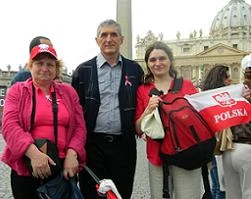
Polish pilgrim Kataryna Katarzyna with her parents

You don’t have to go far in Rome to know that a Polish invasion is underway.

You can hear Slavic accents on every street corner. There are red and white Polish national flags fluttering in the sun. People are wearing t-shirts and hats emblazoned with image of the country’s most famous son, Pope John Paul II, who will be beatified in St Peter’s Square this weekend.

“I think there will be about 100,000 Polish people here. We know at least 40,000 are arriving with organized groups but there are also lots making their own way here,” Polish radio journalist Dorota Piotrawska tells me in St. Peter’s Square.

“Yesterday I met three men, two of them in their 60s, who’ve walked all the way from Poland just to be here to give thanks for our Pope and for all he gave us. Similarly, I met a young man who’s walked from the town of Bialystok in eastern Poland. That’s over 1600 kilometers (990 miles). When I listen to the stories of Polish pilgrims here in Rome and what they’ve given up just to be here, well, I get very emotional.”

One such pilgrim is Kataryna Katarzyna, a 33-year-old student from the Polish city of Lodz, “I’m of the Pope John II generation. I was born the year he was elected Pope. I came to Rome when he died. So when we heard he was going to be a saint both I and my parents said, ‘we must be there!’”

Pilgrims such as Kataryna will be joined for Sunday’s beatification ceremony by the Polish president, Bronislaw Komorowski. Also present will be former president Lech Walesa.

The country’s Prime Minister, Donald Tusk, has opted to spend the day in John Paul’s hometown of Wadowice in southern Poland. There about 20,000 people will pack into the town’s main square to watch events live from the Vatican.