Showing posts with label Eucharist. Show all posts
Showing posts with label Eucharist. Show all posts
Wednesday, January 18, 2012

Friday, June 24, 2011
Lift the City - A Catholic Eucharistic flash mob
Well, it's not exactly a mob :) - but definitely a flash of light:
A Eucharistic flash mob in the centre of Preston, UK organised by the Capuchin Franciscans on Ascension Thursday 2011.
How I wish I could have been there! What a privilege it would be to worship Jesus in public. The end is very beautiful:
h/t Mommmy Life
A Eucharistic flash mob in the centre of Preston, UK organised by the Capuchin Franciscans on Ascension Thursday 2011.
How I wish I could have been there! What a privilege it would be to worship Jesus in public. The end is very beautiful:
h/t Mommmy Life
Saturday, March 12, 2011
New book on the Jewish roots of the Eucharist
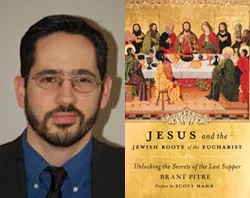 from The Catholic News Agency
Dr. Brant Pitre hopes his new book on the Jewish roots of the Eucharist will help Catholics understand the “great gift” of the sacrament, as well as their privileged role in the “divine drama” of salvation history.
In a recent interview with CNA, Dr. Pitre – a professor of Sacred Scripture at Louisiana's Notre Dame Seminary – discussed his latest book, “Jesus and the Jewish Roots of the Eucharist: Unlocking the Secrets of the Last Supper,” which was released by Doubleday on Feb. 15.
Dr. Pitre said that “excitement” is beginning to hum over the book as people are realizing that “not only is the Eucharist something that's important in their personal lives,” but that all of salvation history held “signs and shadows of what God was ultimately planning to give us in the Eucharist.”
“It makes us realize that we are a part of something much bigger than ourselves,” he said. “We're part of a divine drama that has been in place since the beginning of creation.”
The scholar explained that he was asked several years ago to give a talk on the biblical and historical underpinnings of the Eucharist. What he found during his research for the address, however, was “dynamite – it was explosive,” he said.
“What I began to discover,” he said, “is that there were Jewish expectations surrounding the Messiah” that foreshadowed the Eucharist.
Dr. Pitre recalled that as he studied the historical account of Jewish hopes for the Messiah, three specific aspects of Jewish history and liturgy “really stood out” to him.
The first, he said, was the belief among the Jewish people at the time that the Messiah would institute “a new Passover.” Citing the words of Christ in the Gospel of John, Chapter 6 – often called the Bread of Life discourse – Dr. Pitre said that by telling his disciples to eat his flesh and drink his blood, “Christ is revealing himself as the new Passover lamb.”
“What does that mean about the way we receive salvation?” he asked. It means “we receive salvation not only through faith in him as the Messiah but also by obedience to his command that we would eat the flesh of the lamb.”
“I think it's an important point for Catholics to understand that the Passover paves the road to our understanding of the Eucharist as really being the flesh of the Lamb of God.”
A second aspect of Jewish expectation of the Messiah that stood out to Dr. Pitre was the “belief that when the Messiah would come, one of the ways you'd know who he was, was that he would bring new manna from heaven.”
As described in Exodus 16, Moses gave the Israelites manna – bread from heaven – in the desert to feed them.
When Christ says in the Gospel of John “that the Eucharist is the new manna,” this “tells us that the Eucharist is not just ordinary bread – it's miraculous,” Dr. Pitre said.
“If the old manna from heaven was miraculous bread from heaven, then the new manna in the Eucharist can not simply be a symbol.”
“The manna helps us see that every single Mass, no matter how simple or grand, is a miracle – the miracle of Christ pouring out his body from the heavenly altar on to every altar in the world.”
The third Jewish expectation of the Messiah that Dr. Pitre found was that he “was going to build a new temple.”
The author explained that one of the most important temple sacrifices for the Israelites was the “unbloody sacrifice known as the bread of the presence.”
“The bread of the presence was this mysterious bread and wine that was kept in the tabernacle,” which the rabbi's called the “bread of the face of God,” he said.
“In the temple in Jesus' day they would actually take the bread out of the temple when pilgrims would come for feasts – and they would lift it so all the pilgrims could see – and they would say 'behold, God's love for you,'” Dr. Pitre said, noting the similarities in the exposition during the Mass.
“This bread of the presence really seemed to me to be a crystal clear foreshadowing of the real presence of Christ in the Eucharist,” he noted.
Another echo of Jewish liturgy found in the Mass today, was standard blessing of the bread and the wine said during a Seder, or a traditional Passover meal.
Dr. Pitre recited the ancient prayers over the bread and wine verbatim, saying “Blessed are you, O Lord God, king of the universe, who creates the fruit of the vine. Blessed are you, O Lord God, who brings forth the bread from the earth.”
“Do those sound familiar?” he asked, referencing the beginning of the offertory during the Mass.
“As a Catholic when you see these things, it resonates with you – it's all very close to your heart.”
He underscored that the Jewish people “saw the bread as a sign of the everlasting covenant between God and his people.”
“That's the same thing today with the Eucharist – it is a sign that God is with us, he's not abandoned us.”
Dr. Pitre said that understanding the Jewish roots of the Eucharist helps show how “God has had in store for us, since the dawn of time, the great gift that he gives us in the Eucharist.”
“It helps us to realize the great privilege we have to receive this gift – it's very humbling and powerful.”
Thursday, January 20, 2011
The Holy Sacrifice of the Mass...where our redemption is accomplished
The Second Vatican Council tells us in “Sacrosanctum Concilium” that through the Holy Sacrifice of the Mass — an action of Jesus Christ the High Priest — the work of our Redemption is accomplished.
This is a very important teaching that deserves serious reflection; catechesis that falls squarely into the category of the “necessary liturgical instruction of the faithful” that the Council Fathers insisted our pastors “zealously” provide (cf SC 7).
Let’s be honest, few of us have ever received any such instruction, but if we continue to fail in this area we run an ever increasing risk of falling into the error of viewing Holy Mass as little more than the Catholic version of any number of other Christian praise and worship services when, in fact, it is nothing of the sort.
Think this risk is simply imaginary? Think again.
Data gathered from the Catholic Pluralism Project (viewable online at the Association of Religion Data Archives) estimates that 39% of Catholics polled in 1995 “strongly agree” with the statement, “There is something very special about being Catholic that you can’t find in other religions.” Over 40% indicated that they “could be just as happy in some other church; it wouldn't have to be Catholic.”
So, how did we get here? In no small measure by failing to teach (and to reflect upon) what Holy Mass truly is – the locus of Redemption; a work carried out through, with and in the Catholic Church by Christ our Redeemer.
So with this in mind, I’d like to see if we can get our hands around this critically important truth of our Catholic faith by looking to Pope John Paul II and his Apostolic Letter on the age old mystery of human suffering, “Salvifici Doloris” — a beautiful reflection on “salvific suffering” that was offered during the Holy Year of Redemption in 1984.
While it may seem a bit odd to speak of Holy Mass, the mysteries of Redemption and human suffering as somehow interconnected, please just stick with me and, God willing, it will all come together at the conclusion in Part Two.
Let’s begin by reflecting on the words of St. Paul who wrote of his own suffering to the Colossians saying, "Now I rejoice in my sufferings for your sake, and in my flesh I complete what is lacking in Christ's afflictions for the sake of his body, that is, the Church" (Col. 1:24).
It is often asked of this passage, and for good reason, what could possibly be lacking in Christ’s afflictions? Remember, we are exploring a great mystery of our faith. Therefore, we cannot possibly hope to fully comprehend its true glory, much less sum it up in mere words. Even so, let’s now consider what the Holy Father has to say in “Salvifici Doloris”:
The sufferings of Christ created the good of the world's redemption. This good in itself is inexhaustible and infinite. No man can add anything to it. But at the same time, in the mystery of the Church as his Body, Christ has in a sense opened his own redemptive suffering to all human suffering. In so far as man becomes a sharer in Christ's sufferings — in any part of the world and at any time in history — to that extent he, in his own way, completes the suffering through which Christ accomplished the Redemption of the world.
OK... So now you may be thinking, “Wow, that sounds great, and if I were suffering I suspect this would be a great comfort to me. As it is, however, I’m doing pretty well. I have my health, my kids are happy, my finances are in order, etc...” In which case, I’m very happy for you, but not so fast...
To consider human suffering is to acknowledge that we are still living in exile in this valley of tears, and so the very fact of our present condition — pilgrims who are journeying toward heavenly perfection — means that we are right now, each and every one, “suffering.” No, not because we are whiners and complainers, but because we know that any degree of separation from true Life, in which God is all in all, is the very definition of suffering.
As we continue to reflect upon “Salvifici Doloris,” cognizant that this treatment of suffering applies to each and every one of us throughout our earthly lives, I’m going to occasionally substitute phrases like “the present human condition” in place of the word “suffering” as this, I believe, will help us to see more clearly the connection between Holy Mass, suffering, and the work of Redemption.
The Holy Father continues:
Does this mean that the Redemption achieved by Christ is not complete? No. It only means that the Redemption, accomplished through satisfactory love, remains always open to all love expressed in [the reality of the human condition].
Notice that the Holy Father introduces a new aspect to suffering in the work of Redemption — satisfactory love. Note this well: Redemption is not accomplished by suffering alone, but by suffering in love.
Human beings (even the most holy ones) have been suffering since the Fall, but Christ’s suffering alone can accomplish the work of Redemption because it is unlike any other in that it is ever carried out in perfect love for the Father and for each and every one of us inperfect union with the will of the Father.
Is this suffering of Christ — true God and true man — and the Redemption that it accomplished complete? Yes, but there is still as yet what John Paul II called an “opening” for our lives as realized in our present condition to be lived out as an expression of our own love for the Father and for one another in Christ, and for all of this to have real redemptive value both for ourselves as individuals, and for the Pilgrim Church on earth as a whole.
In Christ... This is very important; it is in Christ alone that we find the Source of Redemption. It is in Christ alone that our love finds true meaning and has eternal value, and it is in Christ that there is room for, and indeed a need for, this human love in the Pilgrim Church, in our world, in our present condition, even though Christ’s love in itself is truly infinite.
Apart from this great glorious mystery of our faith, our own acts of suffering carried out as an expression of our love for God and for one another would be of no more value than trying to put fuel in a car when the tank is full, but human reason and experience alone tell us that our acts of sacrificial love do indeed have real meaning in the lives of all concerned.
The Holy Father goes on:
In this dimension — the dimension of love — the Redemption which has already been completely accomplished is, in a certain sense, constantly being accomplished. Christ achieved the Redemption completely and to the very limits, but at the same time he did not bring it to a close. Christ opened Himself from the beginning to every human [in the reality of their present condition] and constantly does so...
Thus, with this openness to every human person, Christ has accomplished the world's Redemption... at the same time, while this Redemption was completely achieved by Christ, it lives on, and in its own special way it develops in the history of man.
It lives and develops as the body of Christ, the Church, and in the dimension of [the present human condition], by reason of the loving union with Christ, [completing] the redemptive work of Christ.
When we hear the Holy Father speak of “loving union with Christ” our thoughts should immediately go to the Most Holy Eucharist!
“For the liturgy, through which the work of our redemption is accomplished, most of all in the divine sacrifice of the Eucharist, is the outstanding means whereby the faithful may express in their lives, and manifest to others, the mystery of Christ and the real nature of the true Church” (SC 2).
Yes, it is in the Holy Sacrifice of the Mass that the Body of Christ on earth — sojourners on a journey — enter into Holy Communion with their Redeemer and with one another in the most profound way possible this side of heaven!
It is here where “Redemption lives on” — a mystery realized in the reality of our present human condition — and it is here where our examination will continue next week in Part 2.
Friday, January 14, 2011
Lifting the veil clouding His presence...
from patheos.com by Elizabeth Scalia
Spent some time stargazing a while back, when I couldn’t sleep.
No telescope, just the naked eye, a dark neighborhood and a willingness to wonder. I was digesting a bit of Thomas Merton’s The Seven Storey Mountain, and it had stayed with me through evening’s pass – the sight of the stars, the early, wise writings of a monk.
 Does the fact that we can no longer see the stars have anything to do with our loss of wonder? These things, the stars, and all creation – they are more splendid, perfect, beautiful and lasting than anything man can create or even conceive.
It seems like when we were more aware of milky ways and horizons, it was easier to believe. Could Joan of Arc have led her army, could she even have thought to, could she have trusted enough, without having a sense of something greater, bigger than herself?
We have obliterated the stars with our artificial light – but perhaps we’ve blinded ourselves, too. Without the wonder, the greatness of the galaxies in our sight, we’ve lost the ability to believe in, or expect, miracles.
When you cannot see the glory of God’s creation, how can you wish to glorify the Lord? No longer seeing anything greater than ourselves, we turn inward, we worship our own thoughts, our invention, our desire.
Each generation–and perhaps my boomer generation more than any other–thinks of itself as the most enlightened, most informed, most aware, but how can that be?
We see the world through 19 inch computer screens, and 40 inch television screens. We melt the sand to create 36 inch windows, and we think that’s as big as the world gets.
We’ve narrowed our perspective – made it boxed sized and so have boxed ourselves in. And then we blame God for not giving us miracles anymore – and we blame religion for making us expect them.
We are such fools. Merton had it more right than I had realized when he wrote:
And this is why we need the Eucharist. As Merton writes:
And called the Eucharist:
Blinds us by excess of clarity. Yes.
There is a wonderful story about Dorothy Day, who progressed within that excess of clarity until she had denuded herself of all of her worldly possessions except for her breviary and her jar of instant coffee. Even if I could let go of everything but my breviary, I don’t know if I could embrace the humility of instant coffee, but here is the story as Deacon Greg tells it:
Back in the 1970s, when there was a lot of liturgical innovation going on, Dorothy Day invited a young priest to celebrate mass at the Catholic Worker. He decided to do something that he thought was relevant and hip. He asked Dorothy if she had a coffee cup he could borrow. She found one in the kitchen and brought it to him. And, he took that cup and used it as the chalice to celebrate mass.
When it was over, Dorothy picked up the cup, found a small gardening tool, and went to the backyard. She knelt down, dug a hole, kissed the coffee cup, and buried it in the earth.
With that simple gesture, Dorothy Day showed that she understood something that so many of us today don’t: she knew that Christ was truly present in something as ordinary as a ceramic cup. And that it could never be just a coffee cup again.
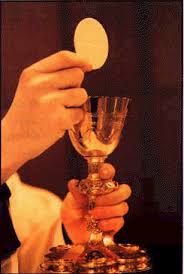
She understood the power and reality of His presence in the blessed sacrament.
Which is really the sum and substance of what we celebrate on this feast, Corpus Christi. The reason for what we will do today – celebrating with the monstrance, the music, the procession – isn’t to glorify an inanimate object, a bit of bread contained in glass.
It is to remind the world that in that bread we have been given Christ.
Not an idea. Not a symbol. Not an abstract bit of arcane theology. No. It is wider and deeper and more mysterious than that.
Look at that host — and you look at Christ. Everything we are, everything we believe, everything we celebrate around this altar comes down to that incredible truth. What began two thousand years ago in an upper room continues here, and now, and at altars around the world. The very source of our salvation is transformed into something you can hold in the palm of your hand.
That’s a homily that deserves a full reading.
And:
“The hidden treasure… is Jesus himself, the Kingdom in person. In the Sacred Host, he is present, the true treasure, always waiting for us. Only by adoring this presence do we learn how to receive him properly-we learn the reality of communion”. (Pope Benedict XVI, address to Religious and seminarians, Altotting, Germany, Sept., 11, 2006)”
Lots to think and pray about. How humbling it all is!
Spent some time stargazing a while back, when I couldn’t sleep.
No telescope, just the naked eye, a dark neighborhood and a willingness to wonder. I was digesting a bit of Thomas Merton’s The Seven Storey Mountain, and it had stayed with me through evening’s pass – the sight of the stars, the early, wise writings of a monk.
It seems like when we were more aware of milky ways and horizons, it was easier to believe. Could Joan of Arc have led her army, could she even have thought to, could she have trusted enough, without having a sense of something greater, bigger than herself?
We have obliterated the stars with our artificial light – but perhaps we’ve blinded ourselves, too. Without the wonder, the greatness of the galaxies in our sight, we’ve lost the ability to believe in, or expect, miracles.
When you cannot see the glory of God’s creation, how can you wish to glorify the Lord? No longer seeing anything greater than ourselves, we turn inward, we worship our own thoughts, our invention, our desire.
Each generation–and perhaps my boomer generation more than any other–thinks of itself as the most enlightened, most informed, most aware, but how can that be?
We see the world through 19 inch computer screens, and 40 inch television screens. We melt the sand to create 36 inch windows, and we think that’s as big as the world gets.
We’ve narrowed our perspective – made it boxed sized and so have boxed ourselves in. And then we blame God for not giving us miracles anymore – and we blame religion for making us expect them.
We are such fools. Merton had it more right than I had realized when he wrote:
The devil is no fool. He can get people feeling about heaven the way they ought to feel about hell. He can make them fear the means of grace the way they do not fear sin. And he does so, not by light but by obscurity, not by realities but by shadows; not by clarity and substance, but by dreams and the creatures of psychosis. And men are so poor in intellect that a few cold chills down their spine will be enough to keep them from ever finding out the truth about everything The devil does rob us of clarity by casting us about in shadows. But he fools us into thinking that the shadows are light. Our illumination is only illusory.
And this is why we need the Eucharist. As Merton writes:
I tell you there is a power that goes forth from that Sacrament, a power of light and truth, even in to the hearts of those who have heard nothing of Him and seem to be incapable of belief.
And called the Eucharist:
…that tremendous, secret and obvious immolation, so secret that it will never be thoroughly understood by a created intellect, and yet so obvious that its very obviousness blinds us by excess of clarity; the unbloody Sacrifice of God under the species of bread and wine.
Blinds us by excess of clarity. Yes.
There is a wonderful story about Dorothy Day, who progressed within that excess of clarity until she had denuded herself of all of her worldly possessions except for her breviary and her jar of instant coffee. Even if I could let go of everything but my breviary, I don’t know if I could embrace the humility of instant coffee, but here is the story as Deacon Greg tells it:
Back in the 1970s, when there was a lot of liturgical innovation going on, Dorothy Day invited a young priest to celebrate mass at the Catholic Worker. He decided to do something that he thought was relevant and hip. He asked Dorothy if she had a coffee cup he could borrow. She found one in the kitchen and brought it to him. And, he took that cup and used it as the chalice to celebrate mass.
When it was over, Dorothy picked up the cup, found a small gardening tool, and went to the backyard. She knelt down, dug a hole, kissed the coffee cup, and buried it in the earth.
With that simple gesture, Dorothy Day showed that she understood something that so many of us today don’t: she knew that Christ was truly present in something as ordinary as a ceramic cup. And that it could never be just a coffee cup again.
She understood the power and reality of His presence in the blessed sacrament.
Which is really the sum and substance of what we celebrate on this feast, Corpus Christi. The reason for what we will do today – celebrating with the monstrance, the music, the procession – isn’t to glorify an inanimate object, a bit of bread contained in glass.
It is to remind the world that in that bread we have been given Christ.
Not an idea. Not a symbol. Not an abstract bit of arcane theology. No. It is wider and deeper and more mysterious than that.
Look at that host — and you look at Christ. Everything we are, everything we believe, everything we celebrate around this altar comes down to that incredible truth. What began two thousand years ago in an upper room continues here, and now, and at altars around the world. The very source of our salvation is transformed into something you can hold in the palm of your hand.
That’s a homily that deserves a full reading.
And:
“The hidden treasure… is Jesus himself, the Kingdom in person. In the Sacred Host, he is present, the true treasure, always waiting for us. Only by adoring this presence do we learn how to receive him properly-we learn the reality of communion”. (Pope Benedict XVI, address to Religious and seminarians, Altotting, Germany, Sept., 11, 2006)”
Lots to think and pray about. How humbling it all is!
Tuesday, November 16, 2010
Nintendo DS in the Communion line?... where were her parents?

from National Catholic Register
I traveled yesterday with my five children to attend my niece’s confirmation. It was a beautiful event that was so well attended my kids and I had to park in a nearby neighborhood.
But there’s a reason I’m telling you the story. Look, I know it can be difficult to have kids in church. Believe me I know. I’ve had kids knocking their chins into the pews and crying, I’ve had kids vomiting and then crying that they vomited, I’ve had kids accidentally tearing the missal and crying because they thought they’d be in trouble. But I couldn’t believe what I saw yesterday at the confirmation Mass.
Mind you, the church was packed so my children and I were standing and couldn’t see a whole lot but in my limited field of vision I saw at least five kids either texting or playing their Nintendo DS in their pew. And I’m talking 9,10,11 year old kids on their DS while sitting right next to their parents.
But the worst part happened later. I saw one 11-ish year old girl walking up to the altar to receive Communion while playing her hand held video game. I guess we all should’ve just been thankful that she had it on mute. The usher who looked like Bowzer from Sha-na-na stood there not knowing what to do. I could see he wanted to say something but he simply looked perplexed. He implored with his eyes Nintendo girl’s parents and an older woman I suspect was her grandmother as they walked past him. But he was ignored. As Nintendo girl walked up the aisle her face reflecting digitized glory I could see Bowser looking around at a nearby usher who also mysteriously looked like Bowzer for an answer on what to do. Bowzer 2 simply shrugged his shoulders as in “Hey watcha gonna do?”
The Church seemed intent on playing “Speed Jesus” because there were probably a dozen Eucharistic ministers. The line moved double time and Nintendo girl got to within about twelve steps of the altar rail before closing the DS, shoving it in her pocket, putting on her solemn face, and receiving the Eucharist.
And while you can blame the kid, to me the real fault lies with the parents for not conveying to their children the importance of the holy sacrifice. And clearly, this child’s parents didn’t feel she was doing anything wrong. Or they knew it was wrong but they just didn’t care.
And let me tell you, before Communion the church was standing room only but right after there were plenty of seats available. So my kids and I sat down in an empty pew like those people at ballgames who move into box seats in the seventh inning after all the people who were just there for business left.
My eight year old daughter looked shocked when she saw a young boy playing a video game and the boy’s sister crowded up next to him watching the screen and whispering instructions. As I looked at that my two year old fell over the kneeler and bent her fingers back and she cried. Loudly. And then -get this- Bowzer 2 looked at me like I was a terrible parent.
I guess he thought that if she had a Nintendo she would’ve at least sat still.
h/t MATTHEW ARCHBOLD
Monday, October 25, 2010
What I Saw In the Chapel...
The Staggering Truth about the Eucharist
Post by Marion Fernandez-Cueto in Faith begins...

In September, the Pew Research Forum on Religion and Public Life released a study about religious knowledge in the United Sates. One of the more sobering results: more than 45% of Catholics are not aware the Church teaches that bread and wine used at Mass are not mere symbols, but actually become the Body and Blood of Christ at consecration.
I am a convert who entered the Church solely for the Eucharist, and while that decision has since been grounded in a deeper appreciation for the entirety of Catholic teaching, I still found the Pew statistic astonishing.
“How can so many Catholics not know about the Eucharist?” I exclaimed to my husband, a revert who had drifted from the Church until his late 20s, when a fearsome and feisty Franciscan nun persuaded him to sample her RCIA classes. (Nine months later he was confirmed—and promptly introduced to me). “How is that ignorance even possible?”
My husband was amused at my incredulity. “Easy,” he shrugged. “I never knew it myself. And you can’t know what you can’t know.”
“But what about your First Communion? What about Mass?” I badgered. “Didn’t you hear the priest say, you know, ‘the Body of Christ,’ every single Sunday? What on earth did you think he was talking about? Why do you think you were saying ‘Amen’?”
Andrés just shook his head. “No one ever spelled it out for me,” he explained. “First Communion was just this social rite of passage, and after that, no one even talked about the Eucharist — not my parents, not my friends, not even the priests. We were just expected to know about it, I guess.”
I still wasn’t satisfied. “Adoration,” I insisted. “You must have known something was going on there.”
“Are you kidding?” my husband said softly. “I’d never heard about Adoration until I met you.”
Suddenly, I understood. Because it was Adoration — not the Mass, not the Catechism, not strenuous apologetics from well-meaning Catholic friends, that first revealed to me the stupendous reality of the Eucharist.
In my late teens, I had been skulking around the Church for about a year — observing random Masses, picking through Catholic literature — when a co-worker invited me to attend a weekend retreat at a monastery. Intrigued by some of the advertised lectures on Aristotle (monks doing metaphysics?!) I accepted.
We had ample downtime between the retreat sessions and meals, and wandering around the monastery grounds one winter afternoon, I stumbled into a small, cave-like chapel. And froze in the doorway.
Before me, ten or fifteen people — habited nuns, monks, and lay persons I recognized from the philosophy sessions—were kneeling prostrate on the thin carpet. At the front of the room was an altar, and on the altar, encircled by a simple gold monstrance, was one of the consecrated Hosts I had often seen at Mass. Candles flickered on either side and the room was bathed in silence and late-afternoon sunlight.
Surely I’d encountered Church teaching on the Eucharist before that moment. But it wasn’t until I saw fifteen otherwise sane, intelligent and delightful people bowing down before a monstrance that I grasped the full significance of that teaching, and it rocked me to the core.
Subscribe to:
Posts (Atom)