Showing posts with label Faith. Show all posts

Wednesday, January 11, 2012

What if we really applied our faith?

Have you ever wondered what would happen if we truly applied our faith to every aspect of our lives?

Take work, for example. Most of us do something every day that could be characterized as work, regardless of whether we collect a paycheck for our efforts or not. Full time Moms, for example, work as hard as any of us – and certainly deserve our profound respect.
But can our faith actually help us to become better at our work? Conversely, can our work help us to grow in our faith?
Absolutely. Consider the subject of teamwork.
Most of us have to work with others on a daily basis who think differently than we do. We need one another, after all – complementary skill sets are a critical component of any team. So what happens when our differences cause friction?
In my experience in organizations large and small, workplace struggles with teamwork are commonplace. So as people of faith, let’s take the first step. To be a better team player, and to strive to serve others as Christ did, try the following:
1. Look for talents in others. We can be of great service to others by recognizing and encouraging their talents – even if it involves the occasional reprimand.
2. Use hurdles as stepping-stones. By our willingness to accept challenges gracefully, we become ever more open to following God’s calling in our lives.
3. Read the Bible and other spiritual books. This is a great way to allow God to speak to us.
4. Be humble. Humility is the foundation of spiritual development, and it holds untold spiritual and practical benefits.
5. Pray for your teammates. If there’s anyone in particular who irritates you, pray for him or her each day. This benefits the team, and it has the power to transform our own hearts.
Recognize that none of these items should cause any heartburn for teammates even the most secular of workplaces. Our faith shouldn’t be an impediment to effectiveness at work – it’s really an asset. Just think of the revolution that would occur if we all lived out our faith just a little bit better in our daily work. Let’s pray for one another!

Note: The above points are excerpted from Faith at Work: Finding Purpose Beyond the Paycheck.

Tuesday, May 31, 2011

With Jesus you're free to lose...

Spirit Daily:

Want to get off the treadmill? Tired of the "rat race"? Exhausted from going "nowhere"? Well, then, get off; all it takes is refocusing on Jesus.

In Christ -- in the Gospels -- we don't have to compete. We're "free to lose." You heard that right: sounds almost unAmerican, doesn't it? It certainly seems counterintuitive (especially when we are surrounded by prosperity ministries).

But here's the point: when we are founded in Jesus -- truly founded -- we don't care what the world thinks of us. We don't need anything but what He provides. With Him, we have standing. We have dignity. We have security. We have peace. We have enrichment of the spiritual kind. We are free when we empty ourselves of "self" and fill it with Spirit. Lose yourself in Him. When you go with the flow of Jesus, you don't need directions.

It's just the opposite with "the world."

The world wants you "winning." It has you straining and gunning and killing yourself to be "successful" by its standards (the standards of materialism) and the result is incredible because not only is it impossible for most to attain all the material riches they want (to be "worth" millions), but even those who do fight their way to monetary "success" find that it brings more pain than anything.

Look at how many rich people and celebrities have trouble putting a smile on their faces. Look at even actors who are nearly billionaires or prominent politicians or "star" athletes and how -- unfulfilled -- they resort to bizarre personal lives. Look at the expression we often use for someone with money: "He has done well for himself." (Key word: self.)

One recent "celebrity" thinks he is "winning" because he has a luxury home, great cars, girlfriends who star in pornographic movies, millions with which to buy drugs (and liquor). Of course, he also has two ex-wives, countless alienated friends, distressed relatives, and children who had to be taken from him.

If that's winning, we don't want to see what losing is.

We look at celebrities destroying their families. How many others do the same -- trying to be celebrated?

It's why they call pride a deadly sin.

And pride is often found in wanting to be admired by the worldly.

The point here: don't care what the world thinks about you.

"My son, says our Savior Christ, you will not take it to my heart, though some people think or say of you evil that you would gladly not hear, for you will think even worse of yourself, and that no man is as evil as you," the Lord said in The Imitation of Christ. "If you are well-ordered in your soul, you will not care much for such flying words. It is no little wisdom for a man to keep himself in silence and in good peace when evil words are spoken to him, and to turn his heart to God and not to be troubled with man's judgment.

"Do not let your peace depend on the hearts of men; whatever they say about you, good or bad, you are not because of it another man, for as you are, you are. Where is true peace and glory? Is it not in Me? Yes, truly. Therefore, he who neither desires to please men nor fears to displease them will have great plenty of peace; for all disquiet of heart and restlessness of mind come from inordinate love and groundless fear."

In the Lord you are free. The truth sets you free. Jesus is "the Truth and the Light." The abundance He gives is real abundance -- sometimes in the way of the material, yes, but mainly in the richness of our inner lives, where the treasures of Heaven are calculated. Christ said He gives life and life more abundantly but He never referred -- not once -- to granting material riches.

Are you free? If not, what are you bound to? Whom are you bound to? What system of belief -- what aspirations -- have you in bondage? These are meditations.

Incredible it is, how we consider health and life insurance so crucial but do nothing to insure our inner, eternal well-being -- our afterlife insurance!

Store up true treasures.

And go for peace now -- by realizing that in Jesus we are free to lose everything we have, that we can lose everything that impresses the world, that we no longer have to enter a room and impress anyone, that it doesn't matter what the worldly think of us.

"Freedom is another word, for nothing left to lose."

Nothing worldly.

You are free to "lose"!

In so doing, you gain everything. 

Wednesday, May 18, 2011

Lord, help with my unbelief

Catholic Womanhood by Jessica Harris:

It's not an exaggeration to say that high school students can be a skeptical group.

A day rarely passes without a few students requesting that I prove something to them. Students are used to accessing information instantaneously – the concept of a mystery as something that cannot be completely grasped by our human minds is understandably frustrating to young people.

While coming up with answers that satisfy the curiosity of my students can be difficult, their honest search for the Truth is both inspiring and challenging. As catechists and educators, we are called to give the Church's teachings to the young people entrusted to us in an authentic, accessible and relevant way.

This raises the question: how do we effectively address more difficult teachings of the Church, teachings that require serious faith?

This week, in my Old Testament class, I explained the connection between the manna, bread from Heaven, that God sent to feed the Israelites in the book of Exodus to the Eucharist. This lead to a class discussion on Jesus' Real Presence in the Eucharist, and several students began to open up about doubts they were having.

In the middle of the discussion, after I had reviewed the basic teaching on the Eucharist, one student, an outgoing, intelligent young man, raised his hand. “Miss Harris,” he asked, “What if I don't believe that the Eucharist is really Jesus? What do I do?” His eyes were wide with sincerity, honestly questioning and trusting that I would have the right answer.

That's one thing I love about teaching. As skeptical as the students are, they still hope that we will have the answers they are looking for.

At that moment, my students were not looking for a Powerpoint presentation, a Youtube video, or a set of scientific data. Without realizing it, they are looking for the Truth; they are looking for God.

I directed the class to the sixth chapter of the Gospel of John. I explained, referencing Scripture, that after Jesus fed the crowd of five thousand with bread, they looked to him for more food, and in a spiritual way, to feed the deep hunger of their hearts.

Jesus told the people, “I am the living bread that came down from heaven; whoever eats this bread will live forever; and the bread that I will give is my flesh for the life of the world." (John 6:51).

I turned the attention of the class to what happened next in the Gospel. Jesus' disciples, who had seen his miracles with their own eyes said, "'This saying is hard; who can accept it?'... As a result of this, many (of) his disciples returned to their former way of life and no longer accompanied him." (John 6:60,66).

I explained that skepticism and doubt towards Jesus' teaching on the Eucharist is not new, revolutionary, or even unusual, by any means. People have been doubting the validity of Jesus' words since he first spoke them 2,000 years ago.

I asked the class, “If Jesus did not mean what he said, if the Eucharist was only a symbol, do you think he would have let his disciples leave him? Do you think he would have told them that they had misunderstood, he didn't really mean that?” After a few moments of consideration, they nodded. I continued, “Jesus was not 'just kidding' about being the Bread of Life. That doesn't mean that the teaching isn't difficult, or that it doesn't require faith. It is possible to believe in the Eucharist, even if we can't prove it, or we can't see it with our own eyes. Peter and the other apostles didn't completely understand what Jesus meant, or how it could be true. But they knew that there was no where else for them to go, and that the Truth Jesus presented them with was worth dying for.”

Just when I thought that I had sufficiently answered the question, another student raised her hand. “But, how do we believe in it?”

I told my students the answer that came from my heart, rather than the textbook. “If you honestly want to pursue the truth about the Eucharist, God will show it to you. He shows us here in Scripture, in John 6. He will also show you in prayer, if you make time for prayer. If you guys are sitting here in front of me wondering if the Eucharist is real, don't just sit and wonder.”

“I have a challenge for all of you,” I continued. “I challenge you to go to the chapel after school today. Kneel in front of the tabernacle and tell God your doubts. If you believe that God created the universe and rose from the dead, don't you think that he could show you the truth about the Eucharist?”

“If you believe in God in general, but have a hard time with certain teachings, ask him to increase your faith. Pray this line, again and again: 'Lord, I believe; help my unbelief!' God will not let you down if you are honestly seeking Him.”

While I don't know how many of my students actually went to the chapel that day in pursuit of God, the Holy Spirit hit me over the head with the importance of urging them to enter into their doubts, rather than ignore them, and to continually pray for an increase in our own faith.

Jessica Harris graduated from Franciscan University of Steubenville in 2008 and works as a youth minister and high school religion teacher in the Diocese of Bridgeport, Connecticut. 

Friday, March 4, 2011

Obedience, faith and perseverance


from donotbediscouraged.com by Fr. James Farfaglia

The word obedience comes from the Latin word ob-audire which means to hear or to listen to. As baptized Catholics we are obligated to obey God and to obey the teachings of his Church. Obedience to God and obedience to his Church is the most liberating experience known to the human person.

“Everyone who listens to these words of mine and acts on them will be like a wise man who built his house on rock. The rain fell, the floods came, and the winds blew and buffeted the house. But it did not collapse; it had been set solidly on rock” (Matthew 7: 24).

Obedience gives us total freedom because we do not wallow in sin, opinion, doubt and error. Let us recall what Jesus said elsewhere in the Gospels: “You shall know the truth and the truth shall make you free” (John 8: 32).

We all know that we live in a time of chaos. There is chaos in the Catholic Church, there is chaos in society and there is chaos in family life. Why is there so much chaos? Disobedience. People are not listening. People are doing their own thing.

Let’s take a look at one example that comes to us from the news media. During the time when John Paul II went on to his eternal reward and Cardinal Ratzinger was elected as his successor, the news media gave us a clear window into the open rebellion still going on in the Catholic Church.

A CNN/USA TODAY/GALLUP Poll found that seventy-nine per cent of the Catholics polled said that the new Pope should change the Church’s teaching on birth control. Sixty-three percent said that priests should be able to marry. Fifty-nine per cent want a change on the Church’s ban on embryonic stem-cell research. Fifty-five per cent said that women should be able to be ordained as priests. Thirty-seven per cent want a change on the Church’s stand against abortion. In addition, forty-nine per cent believe the Church should change her teachings on divorce.

As a Catholic priest I am continually criticized by some and ignored by others because I stand firmly and confidently with the Pope and all of the Church’s teaching. I hear comments from people who say that some people do not come to my parish because they are being told what to do or because I am too strict. We live in an age of rebellion, disobedience and apostasy. Most people do not want to hear the truth and most people do not want to be told how to live their lives, even in the most fundamental aspects of the Christian way of life.

Actually, we can turn to another part of Sacred Scripture and find a perfect description of the times that we live in. St. Paul, in his second letter to Timothy says: “The time is sure to come when, far from being content with sound teaching, people will be avid for the latest novelty and collect themselves a whole series of teachers according to their own tastes; and then, instead of listening to the truth, they will turn to myths. Be careful always to choose the right course…” (2 Timothy 4: 3-5).

The time is sure to come…I believe that we are living in the time that Saint Paul predicted.

Do you remember Cardinal Ratzinger’s famous homily before the Conclave that elected him as Pope Benedict XVI? He spoke to us about the dictatorship of relativism. This is the present situation in the Church and in our society.

Let us recall the words of Cardinal Ratzinger: “We, however, have a different goal: the Son of God, the true man. He is the measure of true humanism. An “adult” faith is not a faith that follows the trends of fashion and the latest novelty; a mature adult faith is deeply rooted in friendship with Christ. It is this friendship that opens us up to all that is good and gives us a criterion by which to distinguish the true from the false, and deceit from truth.”

Today, we all know that the Church, society and families are all in a state of chaos because most people are not listening and most people are doing their own thing. What are you supposed to do in this present and on-going crisis? Be faithful and persevere.

“Take these words of mine into your heart and soul. Bind them at your wrist as a sign, and let them be a pendant on your forehead” (Deuteronomy 11: 18).

Live and defend the Ten Commandments. Live and defend the Bible. Live and defend all of the teachings of the Catholic Church.

We all know that today anyone can find a priest that will tell them whatever they want to hear. We have the great gift of the Catechism of the Catholic Church. If the priest is saying something that isn’t there, move on. Find a priest that is faithful, speaks the truth and has the courage to take a stand.

Obedience is a difficult virtue because sometimes the truth really does hurt. But, we need to conform our lives to God’s will, not our own.

Sadly, today, most Americans do not want to hear the truth. In my life as a parish priest I have seen people walk away from the truth for a simple bowl of lentils. Most of the time, all they wanted to do was to continue with their immoral life-style. The Catechism of the Catholic Church brilliantly explains the connection between sexual immorality and the loss of faith with these words: “The sixth beatitude proclaims, ‘Blessed are the pure in heart, for they shall see God’. Pure in heart refers to those who have attuned their intellects and wills to the demands of God’s holiness, chiefly in three areas: charity; chastity or sexual rectitude; love of truth and orthodoxy of faith” (#2518).

I for one will continue preaching the Gospel and the teachings of the Catholic Church, even if there are five people left in the pews. The Catholic Church is not running a popularity contest. The truth must always be explained with kindness and patience, but we can never compromise that which is true. I am excited by the fact that young people and young families are hungry for real Catholicism. I am very excited to see so many young people and young families at my parish. They provide great hope for the future. They really get it and they are making heroic choices in order to live out the Gospel in a very challenging world.

“I set before you here, this day, a blessing and a curse: a blessing for obeying the commandments of the Lord, your God, which I enjoin on you today; a curse if you do not obey the commandments of the Lord, your God, but turn aside from the way I ordain for you today, to follow other gods, who you have not known”(Deuteronomy 11: 26-27).

Wednesday, March 2, 2011

FAITH MATTERS TO ME: Perfect in God's Eyes

From The Herald News by Brenna Riley

My education in the Catholic faith started from the moment I was born. I was brought into this world by the most wonderful parents, one of which happened to be a Catholic school teacher, while the other’s mother was the director of religious education at the same parish. I entered the same Catholic school at 5 years of age, and my religious education was developed by a variety of teachers until I graduated in eighth grade.

After graduation I furthered my religious education at CCD for two more years, until I completed the sacrament of confirmation. All the while being involved as an altar server and for several years a choir member.

Today, Mass has become incompatible with many people’s busy lives. There is also no emphasis on the importance of being part of a community that shares a belief system. Being part of a Catholic church has taught me more than I could have ever expected, including how to accept myself, how to treat others, and most importantly how to believe in something bigger than myself.

Over the last several months, I have come to realize how my faith affects me as a person. When I go to Mass I am truly a happier person. The other parishioners at my church have become an extension of my family, a whole community of people that love me for who I am. Having a strong religious faith has allowed me to become closer to others and closer to myself through God.

Although I may never know why I was put on earth, I can be content with knowing that God created me the way I am for a reason, and, therefore, even with all my faults, I, like every other person, am truly perfect.

Thursday, February 24, 2011

Coed wrestling: Boundaries, faith and false equality


In high school, I ran cross-country—the only girl on the boys’ cross-country team. Running made me happy and I was good it.

But with no girls’ team at my high school, I churned up the hills with the boys’ team. The miles I’d run with my dad and brothers over the years made competing with the boys’ team as natural as running itself.  (And beating even a few male runners on the racecourse was, I admit, satisfying.)

So I get it.

I understand Cassy Herkelman’s athleticism and her desire to compete against the best athletes around. I really do get that.


Cassy Herkelman, by the way, is a 112-pound high school girl, a freshman at Cedar Falls High School in Iowa. The problem, however, is that Cassy competes with high school boys in a sport where success depends on breaching all the natural boundaries of male-female physical contact. 

She’s a wrestler.

And what I don’t get is her parents’ decision to let her aim her athleticism and competitive drive at the wrestling mat. I don’t get that at all.

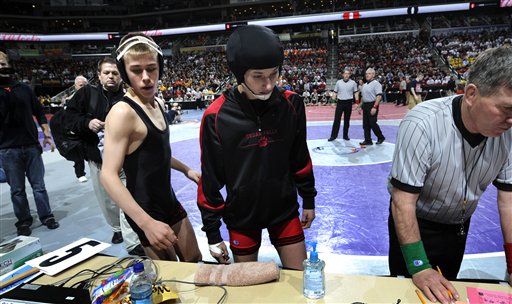
Cassy and another girl wrestler, Megan Black, earned spots in this year’s Iowa State Wrestling Tournament for the first time. But Cassy’s first round match proved to be a test of faith and conviction rather than skill … for her opponent, at least.

Her scheduled opponent, Joel Northrup, was a promising young wrestler who finished third in last year’s tournament. But Joel withdrew from the match, handing Cassy a victory by forfeit.

Why did Joel refuse to wrestle Cassy and, with that refusal, end his title hopes?

Because his faith taught him better than to grapple violently with a girl, grabbing at her body parts for handholds, mentally focused on subduing her. He knew that the sports context didn’t make the contact less problematic. Joel’s strong character propelled him to do the right thing—forfeiting--even though it cost him a shot at the championship he’s worked towards all season long.

To his credit, Joel speaks well of Cassy and acknowledges her athletic talent.  But he goes on to say, “wrestling is a combat sport and it can get violent at times … As a matter of conscience and faith, I do not believe that it is appropriate for a boy to engage a girl in this manner. It is unfortunate that I have been placed in (this) situation…” 

Joel’s right.  It should never have come to this. 

Even if dunder-headed school administrators lacked the common sense to keep girls from wrestling boys, the girls’ parents should never have allowed it. For the girls’ sakes as well as the boys.’

While wrestling moves aren’t overtly sexual and must conform to set rules, wrestling is a contact sport – an aggressive, body-on-body contest. Unlike the jarring, two-second contact of tackle football, wrestling entails sustained grappling, grabbing, squeezing, pressing, and even gouging. As the match progresses, opponents might end up lying on top of each other, wrapping their arms and legs around the other’s torso, or grabbing through the opponent’s legs to flip or pin the other.

“She can take it.”  I can hear the argument now.  But this isn’t a question about whether a girl is tough enough to physically endure those demands on her body.  Certainly an athletic girl can condition her body as well as a boy, and learn the techniques to deftly escape or take down an opponent. 

Yes, girls can be fit, well-conditioned, competitive athletes. But that misses the point.

Throwing girls and boys on the wrestling mat together involves more than relative strength or skill level.

Girls’ bodies are, well, girls’ bodies, different from boys.’ And that physical difference extends to the way they think and feel, as well as their natural inhibitions and inclinations. Our norms about appropriate physical contact are a way ofrespecting those differences.

Consider this: 15-year-old girl wrestlers, like Cassy, must allow a succession of 15-year-old boys (friends? strangers?) to handle their bodies roughly, intimately, aggressively on an open mat in front of a crowd, in an atmosphere of adversarial domination.  And, in order to win, they must respond in kind.

Do we really want a girl to shrug off this kind of contact? To overcome her innate emotional resistance to having her body handled roughly by random males? To accept an adrenaline-driven male grabbing her face, reaching through her legs and flipping her, pinning her? Or for her to grab a teenage boy the same way?

Do we really want our boys to put their physical aggression in high gear against a girl, “fighting” her, while they simultaneously experience her touches and grabs in sensitive areas?

For a boy and girl to wrestle each other requires each to make internal compromises – mental shifts to overcome the ingrained, rightful boundaries we have about how males and females should interact physically.

I believe it’s a good instinct for a girl to recoil from a stranger’s rough touch, especially in intimate areas, just it’s a good mindset for a boy to pull back from causing a girl physical pain or overpowering her in pursuit of physical dominance. 

So what on earth are parents thinking, when they allow their son or daughter to wrestle an opposite-sex opponent? I just don’t get it.

Cassy Henkelman lost her subsequent matches and has been eliminated from the tournament.
She failed to win a medal.

But does she even know what she lost in the attempt?

Mary Hasson, an attorney and writer in the Washington, DC area, is the mother of seven children, and has been married to Seamus for 25 years.  When she’s not writing, she’s likely to be found cheering loudly on the sidelines of soccer games or out on a good run.  She blogs regularly at words from cana

Monday, February 7, 2011

Comparing and contrasting: Super Bowl & Mass, Football & Faith

from blog.adw.org  by Msgr. Charles Pope
I write to you in the midst of a semi-“religious” event: the Super Bowl. People have donned their
sacred attire and are shouting praises. The game really lit up toward the end of the second half and
again in the last quarter. I enjoy football, but see it a lot less since I am a priest and tend to be busy
on Sundays! 

Yet, I remain quite fascinated at how passionate and dedicated many Americans are to the game and 
their team. Would that more Catholics had the same dedication to the Mass and the Church that true 
football fans have for the game. (Fan is short for fanatic). Would too that all priests and religious had 
the same sacrificial dedication that foot ball players have.

Consider for a moment the players. They spend years coming
 up through a system of high school, college and professional
levels. Priest and religious do as well. Football players give
their all to the game. Their whole life is centered on it.
Exhausting, year-long practices, weight lifting and punishing
games. They risk injury, and suffer many pains, all for the game.
Do priests and religious show the same dedication and are
they willing to make the same kind of sacrifices for Jesus?
Will they risk injury and attack? I pray we will and do,
but I wonder. True, we are not paid multi-millions, but we don’t do it for the money. Are we as
dedicated and sacrificial?

And what of the faithful? So many Catholics are dedicated to the game. They even come to Church
wearing the jersey of their team and someone else’s name on their back!

Let’s compare and contrast some of the aspects of football and see if the same kind of thrill
and dedication are exhibited to the Lord, the Mass and the Church.

Disclaimer – I write a lot of this “tongue in cheek.” I am not brooding over this, just observing.
I am also using a technique known as hyperbole. Hyperbole uses exaggeration to make a point.
For example the phrase, “There must have been a million people there” is an exaggeration that
is not literally true but does convey the truth that a lot of people were present. Please take
these comparisons in the light-hearted
manner they are intended.

That said, the point remains a serious one: that we often exhibit unusual priorities when it comes
to worldly vs. spiritual matters. We do well to humorously look at ourselves in order to ask God
for a greater passion for what matters most. Football is about a bag full of air going up and down
a field. Faith is about our eternal destiny.

Consider the following Super Bowl behaviors and contrast them to Mass and the faith:

Wednesday, December 29, 2010

Healing after tragedy: Mary Beth and Steven Curtis Chapman

s

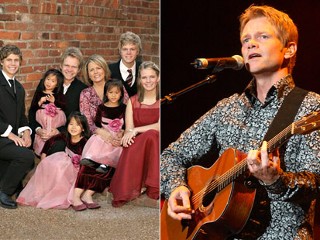
Grammy-winning Christian music star Steven Curtis Chapman and his family suffered a profound loss on May 21, 2008 when his 5-year-old daughter Maria Sue was accidentally hit by his 17-year-old son, after she ran into the path of his SUV in their driveway. Maria later died at a Nashville hospital.

For 5-year-old Maria Sue Chapman, singing was a family gift that came easily. After all, her father was a multiple Grammy and Gospel Music Association award-winning megastar.

The 45-year old Paducah, Kentucky native and his wife, Mary Beth, were already the parents of three biological children, yet they were encouraged and inspired by their daughter Emily to visit and adopt three little girls from China -- Shaohannah, Stevey Joy and their youngest, Maria Sue.

Chapman's wife, Mary Beth, details the highs and lows of her life in her memoir, "Choosing to SEE: A Journey of Struggle and Hope."

In Choosing to SEE, Mary Beth Chapman shares what it's like to be the wife of a star musician and opens up about the pain of her daughter's death.

Sunday, December 19, 2010

Can we learn from Muslim devotion?


from Catholic.net...

Peter Kreeft, a professor of philosophy at Boston College and well-known Catholic apologist and author of over 45 books, engaged in a two-hour debate with Robert Spencer, an internationally known scholar and major critic of Islam.

Both men shared their common and opposing views on Islam before a full audience of spectators. While the men seemed to agree that strict adherence to the Muslim faith can, for some of its 1 billion followers, lead to violence and the mistreatment of women, Spencer likened the peaceful Muslim who does not follow such thinking to a lax Catholic who "practices birth control or support legal abortion. They are defying their religion, because they do not have the authority to reform to it," he said.

In the debate, as well as in his book, Between Allah and Jesus, Kreeft focused on the "theological essence of Islam, which is a radical submission to the will of God." He compared the devout Muslim’s readiness to serve God to the "humility and obedience displayed by Christian saints."

He also commented that this example could serve as a lesson to today’s Catholics, "who all too often treat the demands made by their own faith as mere suggestions, to be taken or rejected by the self-directed individual conscience."

Kreeft followed his assertions by adding that Muslims have high birth rates and they reject both abortion and pornography: "[Muslims] postpone gratification, and pay forward the gift of life to new generations -- something far too few Christians are doing in our time.”

He also added that good Muslims can act, and have acted, as our allies in "international culture wars." Kreeft cited the fact that Islamic states have voted along with the Holy See and other Catholic countries within the United Nations to defeat population control programs that were supported by formerly Christian countries in Europe.

The philosopher said he views the secular movement in Europe as more much more damaging to society than the theocentric mentality of Muslims. "Our real enemies, as Christians, are demons," said Kreeft. "It's all too easy […] to think that Muslims or Communists are the problem, and if we can only defeat and subjugate them the Church will triumph."

He went on to say that "secular enlightenment," which rejects God completely, "is far more dangerous to our souls than a world religion that is devoted to worshipping the same God as Christians and Jews, albeit in a partial, somewhat primitive and distorted manner."

Kreeft focuses on the commonality between the three major faiths: "Large elements of Islam are identical with Judaism and Christianity -- because that's where Mohammad got them."

"In a profound sense," the apologist added, "Islam and secular West are mirror images of each other."

Woman's journey to the Church took 18 years...


from the Georgia Bulletin, Archdiocese of Atlanta...

It is easy to see after spending just a few minutes with Tiara Chivers that her faith is very dear to her. She clearly remembers her experiences as a child and has kept a scrapbook of significant mementos from her adult faith life also.

One of her earliest memories is attending a Protestant church with her parents and older brothers. It was an important time for her as a young girl growing up in Michigan because she always felt a connection with God and the church. However, she remembers that it wasn’t long before she was attending services all by herself.

“As I child I would go to church with my family, but very quickly my parents and my brothers kind of fell off of going to church,” she said. “But some of my earliest memories are of my mom making sure I went.”

“I was so excited. I loved church,” she added.

Chivers continued attending services alone, always taking with her a handkerchief neatly packed with coins for the collection given to her by her mother. As she entered her teenage years she began “hitchhiking” to church, asking friends and neighbors if they were going on Sunday so she could ride along.

When she was 15, Chivers participated in a foreign exchange program that sent her to study and live with a Catholic family in Madrid, Spain. She learned about Spanish language and culture and, especially, about the faith of her host family.

“I remember going to Mass, and I remember vividly walking in . . . and it just felt like home,” she said.

Even though the Mass was celebrated in a language she could not fully understand, she felt an immediate connection to the liturgy.

“I was at peace. I just knew that was it,” she said...Read on...

Sunday, December 12, 2010

Stories of 4 young believers...

from Sioux City Journal
Zach Thomas, Briar Cliff junior, music education major from Council Bluffs, Iowa:
“Before I got to Briar Cliff, I didn't belong to any religion. My parents don't go to church. I actually came here and discovered faith. When I got here, I realized that something was missing. I would look at my friends and notice that they had something I didn't have and wanted that for myself. So I took it upon myself to explore the church and I found the Catholic Church had a lot of things that I agreed with, that appealed to me.”
Freshman roommate George Carmona started taking him to church services and events, a 30-hour fast, the Busy Persons and Antioch retreats. And he opened a Bible for the first time.
“Sometimes there was definitely a lot to learn, but I had a hunger for it.”
Last year, he experienced baptism, first communion and confirmation. This year, he is sponsoring another student on campus.

Wednesday, December 1, 2010


A couple weeks ago I was half paying attention to a documentary about a maximum security prison while folding laundry. They were interviewing a 25-year-old “lifer,” and he mentioned that he used to be on death row but his sentence was commuted to life without parole. The producer asked him to describe what it was like to be released from death row.


He gazed into the distance and responded, “You can’t imagine. When you’re on death row, it’s like you’re already dead. You try to play cards, but you hear that clock ticking in your head, knowing that the date of your extinction has already been set, and now it’s just a matter of days and minutes. You could read a book, watch some TV, but why? You’re gonna die soon and can’t take none of that stuff with you, so it doesn’t really matter anyway.” He got choked up as he added, “I got my whole life back when I got off of death row.”


As I folded a t-shirt I nodded knowingly, subconsciously reacting to his description in a spirit of camaraderie. I instinctively viewed him as someone with whom I had a shared, rare experience, knowing that the producer and the viewers of the show could never imagine what it was like because they hadn’t been there like we had.


I stopped cold with a shirt half folded in my hand when I became aware of my reaction. Where did that come from? How on earth could I, a middle-class girl who’s never even been to the county jail, have the faintest idea what a former death row penitentiary inmate was talking about?


And then I realized: because when I was an atheist, I lived on death row.


I first realized the gravity of my sentence when I was around 11 years old. One night the thought of death randomly popped to mind, and for the first time I fully internalized the reality that I would one day die. Though of course I already knew that nobody lives forever, this was the first time that that veil that blocks unpleasant truths from our conciousness was pierced and I understood down to my bones that it was only a matter of time before a coffin lid closed on top of my body. The weight of that reality was too much for my intellect to bear; it’s like I thought about it more in my racing heart than in my head. My whole being was aware that everything I thought of as “me” — my body, my feelings, my loves, my thoughts, all my hopes and dreams — were nothing more than the products of random chemical reactions that would one day cease, and “I” would disappear.


The human psyche is surprisingly good at blocking out these sorts of unbearably heavy realizations, so I managed to get out of the tailspin of despair within a couple of days and not put any more serious thought into death for a few years. But then high school and college rolled around, I became more curious about life and the world, and the reality of death began to swirl around the periphery of my thoughts once again. Most of the time I could keep my mind occupied with school and friends and parties, but every now and then that veil would fall down again and the reality of death would go seeping down into my bones, leaving me too depressed to cry.


For some reason most of my other atheist friends didn’t seem to struggle with this sort of thing, but I didn’t understand why not. As atheist Bertrand Russell once pointed out, all the efforts of our lives were to be multiplied by zero in a matter of years. With no eternal “self” or even “memory” beyond the grave, it would be as if we never existed. Sure, we would live on in people’s memories, but all of humanity would one day be gone. And measuring by the universe’s timescale, all life on earth — let alone one human’s life — would not even amount to a blip on the radar screen.


The date of our extinction was coming up soon, getting closer by the second. The only difference between a death row inmate and anyone else, in my eyes, was that the prisoner knew the date. I had those same questions that inmate expressed: Why play cards? Why watch TV? Why read a book? Sure, you might have momentary pleasure or gain some knowledge, but it was all fleeting, and it would all disappear — along with you — upon your impending extermination. And the clock was ticking. We were all dead men walking.


It felt wrong — deeply, uncomfortably wrong — to think about all of this. And upon my conversion to Christianity I realized why:


That crushing despair I experienced when I would absorb the implications of my worldview was the feeling of a precious, eternal soul railing against the injustice of being denied. Somewhere in that part of my mind where primal truths too important for words reside was the knowledge that “I” was something more than just randomly evolved chemical reactions, that “I” was both body and eternal soul, that “I” had the opportunity to spend eternity in a place of perfect peace, and that to believe otherwise was the biggest mistake a person could ever make.


When I first came to believe the truth of Christian doctrine, I didn’t think much about the eternal implications. I’d gotten good at distracting myself from thoughts of death and I didn’t want to bias my research into Christianity with a desire to believe in eternal life. So it was only slowly, over time, that I became aware that I was freer than I used to be, that life seemed more complete in a certain way than it had been before. But I couldn’t quite put my finger on what it was.


Then one day I was driving through an intersection where the stoplights had just lost power, and I barely missed getting into a serious, possibly deadly, accident. It was then that I realized what that new “something” was: fear of death no longer haunted me. I no longer saw the end of my life on earth as an abyss of nothingness; rather, I understood it as an opportunity to finally go home. The sleepless nights, the frantic search for distractions, the restlessness that comes with seeking a constant state of denial were all gone.


Though it had happened gradually, when I compared my new state of mind with my old one I felt lighter than air; the foundation of my subconscious was now paved with joy instead of despair.


In that moment I realized that I’d spent my whole life falsely condemned to death row. And now I was finally free.


This post was originally published on February 2, 2009.

Wednesday, November 3, 2010

What do we do with broken things?


Throw it out? Store it? Attempt to use it? Mend it?


If someone took a quick inspection of my closets, basement, and garage, it would reveal an accumulation of broken things. Some people are obsessed with keeping such stuff--my late husband, in particular--in the event that it might be useful someday. On the other hand, I tend to be an impulsive thrower-outer especially if something is broken. It seems more trouble than it's worth to fix it.


The older we become, the more broken things of the spirit and emotions we accumulate. Such intangibles hurt even more than a broken arm. People move and places change. Landmarks disappear. Our roots are severed—parents are gone along with our childhood memories. When our children grow up and leave home, we feel that distance and time have broken off our branches.


Our roles in life change with the ever-circling years. Our self-worth and influence feel fractured. Can we afford to cry over such breaks? Is it worthwhile to waste today's priceless limited time gazing in the rear view mirror of yesterday?


Why should we apply band-aids to broken things of our past when God has brand new adventures available to us?


Broken things are space-wasters of the spirit that clutter our heart-garages and mental-attics. The Holy Spirit is the Great Motivator, the Eternal Prompter; He draws us, pushes us, and impels us to keep moving on to new things instead of hugging broken things. "Behold, the former things have come to pass, now I declare new things; before they spring forth, I proclaim them to you" (Isaiah 42:9).


Sometimes the Lord deliberately severs our roots to pull us out of the hardened soil of the familiar that prevents us from stretching and growing to our full potential. As maturing Christians, let's not allow memories to become ponderous anchors for our life ships to hold us back from sailing over the wide ocean of what God has prepared for us.


When we leave a broken relationship behind, precious though it may have been—or painful—just over the horizon may be a surprising new relationship. A broken job or broken health may motivate us to unfold wings we've never tried before. Broken things are part of God's intensive care for us. He intends them for our good.


God's marching order regarding broken things is, "One thing I do: forgetting what lies behind and reaching forward to what lies ahead, I press on toward the goal for the prize of the upward call of God in Christ Jesus" (Philippians 3:13,14).

Sunday, October 24, 2010

LOL..Laugh Out Loud...a foretaste of what awaits us in heaven

Post from The Integrated Catholic Life Blog begins...
G. K. Chesterton once said, “Angels fly because they take themselves lightly.” What a beautiful concept; realizing that it is not us, but God that carries the weight of the world, thus making us free from the gravitational pull of our own importance. 
When I am in the company of great men and women of faith, I am often “awe” struck by their quick wit and sense of humor. I can only think that it is their humility, their absolute faith that God is so much bigger than they, that allows them to surrender entirely to His mercy and at the same time do so with a smile. There truly is a “lightness” to one who knows that he is nothing and God is everything. For those who believe they are everything, seldom wear such a smile of contentment.
As a society, we often look to God during times of trial and suffering, and although this is good, for sometimes God’s mercy is packaged in such a way that we are forced to stand up and take notice, at times it leads us to believe that happiness and laughter are separate from our relationship with our Creator.
Laughter is endearing.  It is said to “be the shortest distance between two people.” (See, that right there is funny, following a quote by Chesterton with one by Victor Borge… Now, if I could only find a Nipsey Russell quote…) But, Mr. Borge has made a very accurate statement. There is something about laughing with another person that draws us closer to that person, establishes a sense of trust and builds a sense of confidence.
Just think of Sarah’s reaction as God informs Abraham that Sarah, in her old age, will bear a child. The second she laughs, she is drawn closer to God. In fact, He delights so in her humanity, which He created, He instructs them to name the child Isaac, the Hebrew word for laughter. Just think of how Sarah’s confidence in God grew as the child in her womb grew, and how her trust in the Lord intensified as the pains of labor intensified and she bore a son.
Genuine laughter cannot be forced.  It is something so true and so real.  It is something that shows us the Holy Spirit is working deep within us, at the sight of our innermost emotions. Think about the inner warmth you feel as you find yourself doubled over and tears flowing from your eyes in laughter. That passionate response of happiness that encompasses both body and soul can only be a mere foretaste of the happiness that awaits us in heaven.