Showing posts with label John Paul II. Show all posts

Tuesday, April 26, 2011

Remembering Pope John Paul II by George Weigel


Strange as it may seem, I’ve been vaguely worried about the beatification on May 1 of a man with whom I was in close conversation for over a decade and to the writing of whose biography I dedicated 15 years of my own life.

My worries don’t have to do with allegations of a “rushed” beatification process; the process has been a thorough one, and the official judgment is the same as the judgment of the people of the Church. I’m also unconcerned about the fretting of ultra-traditionalists for whom John Paul II was a failure because he didn’t restore the French monarchy, impose the Tridentine Mass on the entire Church, and issue thundering anathemas against theologians and wayward politicians. No, my worries have to do with our losing touch with the qualities of the man.

When the Church puts the title “Blessed” or “Saint” on someone, the person so honored often drifts away into a realm of the unapproachably good. We lose the sense that the saints are people just-like-us, who, by the grace of God, lived lives of heroic virtue: a truth of the faith of which John Paul II never ceased to remind us.

So what would I have us remember and hold fast to about John Paul II?

First, I hope we remember that everything he did was the accomplishment of a radically converted Christian disciple. His resistance to the Nazi occupation of Poland; his abandonment of his youthful plans in order to enter an underground seminary; his dynamic ministry in Cracow as priest and bishop; his philosophical and literary work; his efforts at Vatican II; his epic pontificate and its teaching; his role in the collapse of European communism and in the defense of the universality of human rights—all of this flowed from his radical conversion to Christ.

Why is this important to stress? Because it’s his connection to the rest of us. There are over a billion Catholics on this planet; very few of us will enjoy the range of intellectual, spiritual, literary, athletic, and linguistic gifts that God gave Karol Wojtyla. Because of our baptism, though, all of us share with him the possibility of being radically converted Christian disciples. All of us can be Christ’s evangelical witnesses in our families, our work, our neighborhoods. All of us can live as though the truth John Paul II taught—that Jesus Christ is the answer to the question that is every human life—is at the very epicenter of our own lives.

The second thing I hope the Church holds onto, as it enrolls John Paul II among the blessed, is the significance of the date of his beatification: Divine Mercy Sunday. John Paul’s fondness for the Divine Mercy devotion, and his designation of the Octave of Easter as Divine Mercy Sunday, struck some as a Polish imposition on a universal Church. Those who thought this were mistaken.

John Paul II had an acute sense of the gaping holes that had been torn in the moral and spiritual fabric of humanity by the murderous cruelties of the 20th century. A century that began with a robust human confidence in the future had ended with a thick fog of cynicism hanging over the western world.

As he wrote in his striking 2003 apostolic letter, “The Church in Europe,” Christianity’s historic heartland (and, by extension, the entire western world) was beset by guilt over what it had done in two world wars and the Cold War, at Auschwitz and in the Gulag, through the Ukrainian hunger famine and the communist persecution of the Church. But having abandoned the God of the Bible, it had nowhere to turn to confess this guilt, seek absolution, and find forgiveness.

That, John Paul II was convinced, was why the face of the merciful Father had been turned toward the world now. The insight came from Poland; the need was universal. That was why he created “Divine Mercy Sunday.” That is why we should remember that he was beatified on that day.

Thank God for such a life, in our time.

George Weigel is Distinguished Senior Fellow of the Ethics and Public Policy Center in Washington, D.C.

Saturday, April 9, 2011

Tribute video to John Paul the Great

As the Vatican prepares for the beatification of Pope John Paul II, this 17-minute commemoration looks back at his pontificate through images and video clips of his extensive travels, highlighting his seven visits to the United States and the mutual affection that developed between the pope and the American people.

Thursday, April 7, 2011

When will be John Paul II’s feast day?

From The National Catholic Register by Edward Pentin

When will be John Paul II’s feast day?

So far there’s no agreement but it’s currently the subject of discussion among senior Vatican officials.

Papal spokesman Father Federico Lombardi told reporters this week the date will be announced on May 1, the day Benedict XVI celebrates the beatification Mass.

According to some authoritative sources, October 16th - the date of John Paul II’s election - is the most likely choice. But this would be rather surprising given the fact that the Vatican is keen to stress John Paul II is being beatified on account of his personal holiness rather than his achievements as pope, or impact on history. Another date being floated is that of his inauguration, October 22nd. A date related to Our Lady of Fatima is another possibility.

Most beatified popes’ feast days are chosen to commemorate the date they entered Heaven (in John Paul II’s case, that would be April 2nd) and this has applied to almost all beatified popes.

But exceptions have been made, notably Blessed Gregory X (pope from 1271 to 1276) and, most recently, Blessed John XXIII (1958-1963) whose life is celebrated on 11th October, the anniversary of his opening of the Second Vatican Council.

The feast day of Blessed John Henry Newman, one of the Church’s most recent figures to be beatified, is on October 9th, the date he was received into the Catholic Church.

Which date do you favor for John Paul II the Great?

Wednesday, April 6, 2011

Cardinal recalls John Paul II's commitment to the Blessed Mother.

From EWTN News

Cardinal Giovanni Coppa recently recalled John Paul II's commitment to the Blessed Mother.

The former nuncio to the Czech Republic noted that the late Pope wrote the opening lines of a St. Louis Marie de Monfort prayer at the top of each page of his writings.

Cardinal Coppa said it was the John Paul II's custom to write the words from St. Louis Marie de Monfort’s prayer at the top of each page, beginning with the phrase “Totus tuus,” which was his papal motto.

“The Pope not only recited this prayer every day, but he also wrote part of it on the right-hand corner of each page of his homilies, speeches and encyclicals,” the cardinal told L’Osservatore Romano on April 1.

“On the first page he wrote the beginning of the prayer: Totus tuus ego sum, ‘I am all yours;’ on the second page, Et omnia mea tua sunt, ‘And everything I have belongs to you;’ on the third, Accipio Te in mea omnia, ‘I put you at the center of my life;’ and on the fourth, ‘Praebe mihi cor tuum,’ Give me your heart’.”

He repeated the lines on every page of the document in question, Cardinal Coppa recalled.

“At the archives of the secretary of state we have thousands of these pages on which John Paul II intimately and movingly expressed his love for the Virgin Mary,” he added.

This custom practiced by the pilgrim Pope showed that “his love for the Virgin Mary was a love without limits,” the cardinal continued. “He never lost an opportunity to speak about Mary. He dedicated his encyclical 'Redemptoris Mater' to her: redemption in fact became the common thread of his entire Petrine teaching.”

Vatican plans 'spiritual journey' for John Paul the Great's beatification

From The Catholic News Agency

Perhaps the grandest beatification ceremony ever celebrated –­ the May 1 beatification of Pope John Paul II ­– will be divided into stages to maintain a solemn spirit across three days of prayerful preparation, celebration and thanksgiving.

Cardinal Agostino Vallini, the Pope's vicar for the Diocese of Rome, called the long beatification weekend a "spiritual journey" at an April 5 press conference held to present the details of the much awaited event.

The actual ceremony is set for the morning of May 1, sandwiched between an evening prayer vigil and a thanksgiving Mass the following day.

As pilgrims arrive to the Eternal City by bus, ferry, and even "charter trains" on April 30, they are invited to join together at the Circus Maximus –­ a great field in the center of Rome once used for chariot races –­ for a prayer vigil. The vigil will be both "universal and very Roman," said Cardinal Vallini as he described the major elements of the gathering.

It is to be divided in two parts. The first is a celebration of the memory of the late pontiff. A choir and orchestra will provide the music as the image of Our Lady of Rome, Maria Salus Populi Romani, is processed into the venue.

Three people who were deeply affected by Pope John Paul II will be present to give their testimonies. His spokesman, Joaquin Navarro-Valls, his personal secretary, Cardinal Stanislaw Dziwisz, and the religious sister miraculously healed of Parkinson's disease through his intercession, Sister Marie Simon-Pierre, will all speak of the Pope's effect on their lives.

A second moment will be the prayer of the luminous mysteries of the Rosary. The Circus Maximus will be connected by video to five Marian shrines around the world and each of the five decades of the Rosary will be dedicated to an intention held dear by Pope John Paul II.

Those taking part in the live video feed include: the sanctuary of Divine Mercy at the Lagniewniki Shrine in Krakow, Poland; the Kawekamo Shrine in Bugando, Tanzania; Our Lady of Lebanon Shrine in Harissa, Lebanon; the Basilica of Holy Mary of Guadalupe in Mexico City; and the Fatima Shrine in Portugal. The prayer intentions will be for the youth, the family, evangelization, hope and peace for nations and the Church.

Pope Benedict himself will join by video for a final prayer and to impart the apostolic blessing on the faithful.

Father Federico Lombardi, SJ, the Vatican spokesman, said that parishes and Catholic communities everywhere are invited to take part in simultaneous prayer initiatives.

Though the prayer vigil is scheduled to finish at 10:30 p.m., the prayerful preparation and "spiritual journey" will continue through the night. A total of eight parishes will be open through the night to provide places for worship and confession as the faithful make the pilgrimage across the historic city center to St. Peter's Square for the morning beatification ceremony.

Many of the faithful are expected to spend the night under the stars as they await the start of the beatification celebration. The Opera Romana Pelligrinaggi—the agency charged with coordinating the events—will have drinks and snacks available at refreshment stands to keep pilgrims sustained as they wait for the square to open in the early hours of the morning.

A Twitter account has also been set up through the Vatican's Pope2You website, whereby pilgrims can "tweet" about the experience as it unfolds and those interested around the world can follow along.

At 9:00 a.m., the throng of pilgrims will join together in an hour of prayer, beginning with the Divine Mercy Chaplet and finishing with an invocation of mercy over the whole world.

The beatification ceremony and Mass will then be presided over by the Pope, with cardinals concelebrating. When the Pope pronounces John Paul II a "blessed" and thus one step closer to official sainthood, an enormous image of the Pope will be unveiled in the square.

For the enormous turnout - estimated at around 400,000 - there will be 14 "maxi-screens" set up in the square and down the street leading out of it so the faithful can follow along.

There will be 500 priests distributing communion to the faithful in St. Peter's Square and the outer Pius XII Square. Another 300 will be available to offer the Eucharist to those pilgrims who are expected to fill the street leading up to St. Peter's.

Churches around Rome will also offer communion during the beatification Mass for those who seek it.

A half hour after the Mass and following a visit from Pope Benedict and the cardinals to render him homage, John Paul II's coffin will be available for veneration within St. Peter's Basilica. The coffin, however, will not be opened.

It will remain in its place until the last person who wishes to see it has done so. Fr. Lombardi said that this could even mean that visits extend into May 2.

On May 2, Cardinal Tarcisio Bertone will preside over the final moment of the beatification celebrations. He will preside over an open-air thanksgiving Mass in St. Peter's Square to wrap up the three-day spiritual journey.

One of the priests joining Cardinal Vallini and Fr. Lombardi at the April 5 press conference, Fr. Cesar Atuire of Opera Romana Pelligrinaggi, used the famous Italian words of John Paul II to invite all comers. For pilgrims who might come if not for perceived difficulties with accommodations or other services, he said, "Non abbiate paura!" (Do not fear!)

Costs are being kept down by an "ethics card" signed as a contract between organizers and local businesses to keep them honest.

"There is space for everyone and the organization we are putting in place will be able to serve all comers," concluded Fr. Atuire.

Pilgrims, he said, can aid in the preparation process by registering online at www.beatusjpii.org.

Tuesday, March 29, 2011

300,000+ may attend John Paul the Great's beatification


Church and local government organizers are planning to accommodate at least 300,000 people in St. Peter's Square and the surrounding area for Pope John Paul II's beatification Mass May 1.

Msgr. Liberio Andreatta, head of Opera Romana Pellegrinaggi, the Vatican-related pilgrimage agency, told reporters March 29, "Rome is ready to welcome every pilgrim who wants to come. Earlier, newspapers published megalithic numbers and said every hotel is booked. That's not true."

Father Cesare Atuire of Opera Romana Pellegrinaggi said as soon as Pope Benedict XVI announced the beatification date, travel agents and others booked large blocks of hotel rooms. Now that the beatification is just a month away, they have a more precise idea of how many rooms they will need and so they are freeing up the extras.

In addition, he said, two campgrounds outside of Rome will be reserved for pilgrims who want to keep their costs to a minimum. The commuter trains, which usually do not run on weekends, will be on a special schedule to get them to the prayer vigil April 30 in Rome's Circus Maximus and to the Mass the next morning.

Because the pope is the bishop of Rome and the pilgrims will spend most of their time in Rome, not at the Vatican, the Diocese of Rome is responsible for much of the cost of the event, Msgr. Andreatta said.

The diocese is passing the collection basket to large Italian companies to come up with at least $1.7 million to cover the costs of handling 300,000 pilgrims for the beatification, Msgr. Andreatta said.

Although the city of Rome and its hotels, restaurants and shops will benefit financially from the pilgrims, Msgr. Andreatta said the financial crisis still weighing on Italy made the diocese look to donors instead of the local government for funding.

The money will cover building a stage and installing a sound system and lighting at the Circus Maximus, running extra buses, covering the cost of the bus and subway tickets included in the pilgrim's package, renting and erecting crowd-control barriers and renting dozens of large video screens.

The screens will be placed in the squares around the Vatican and in most of the churches in the historic center of Rome so that people who cannot get close to St. Peter's Square or would prefer to stay away from the crowds can still follow the Mass, he said.

An Italian beverage company has donated 1 million bottles of mineral water, he said, and a restaurant chain has donated the ingredients for thousands of box lunches.

Father Atuire said that as of March 29, the largest numbers of pilgrims were coming from Italy, then Pope John Paul's native Poland, followed by Spain and the United States.

Opera Romano Pellegrinaggi has launched a special website -- www.jpiibeatus.org -- to assist pilgrims with reservations and information. The information is available in five languages, including English.

Friday, February 25, 2011

Romans recall fond memories of John Paul II and look forward to May 1 beatification of their bishop

With more than a million people expected to descend on Rome for Pope John Paul II’s beatification May 1, the event is being described as yet another pilgrim “invasion” of the Eternal City.
Because the beatification falls on a public holiday, some have predicted a massive exodus by Rome residents eager to escape the logistical problems caused by such a big crowd.
But Church officials say that Romans, in fact, may represent the biggest group at the beatification, for a very good reason: For them, Pope John Paul was not only a pope, but also a pastor.
The late Pope took the title “bishop of Rome” seriously, visiting the city’s parishes, prisons, schools, hospitals and soup kitchens. He even held an annual audience with Rome’s garbage collectors.
CNS photo by Arturo Mari“John Paul II managed to get close to the Roman people, and he’s still very much present in their minds. Even Romans who were not great believers were touched by him,” said Giancarlo Distante, who works in a bookstore near the Vatican.
“Sure, it’s tempting to escape the city May 1. But I think the joy of seeing this man beatified is going to keep a lot of people here,” Distante said.
The Diocese of Rome has even organized its own special event, a prayer vigil the night before the beatification, which will take place in the open area that was once the ancient Circus Maximus. Hundreds of thousands are expected to attend.
When Pope John Paul II was elected in 1978, Romans flocked to St. Peter’s Square and were shocked to hear that a certain Karol Wojtyla would be the new pontiff — the first non-Italian pope in more than 450 years. But the new Pope quickly won the crowd over when he gave his first speech in Italian and invited people to correct him if he made any linguistic mistakes.
The Polish Pope worked hard to build bridges in Rome, carrying on with the pastoral work that he had enjoyed so much as archbishop of Krakow. In an effort to better know his flock, he visited more than 300 of Rome’s 334 parishes, providing every Roman neighborhood with moments of celebration and excitement.
Those visits were not limited to a papal Mass. Typically, the Pope met with parish groups, chatted with young people and toured the facilities. Romans had the sense that this Pope had come to learn about them as well as preach to them.
Pope John Paul met routinely with Rome city officials, and he did not hesitate to weigh in on social and moral problems. He often did so from places that had rarely, if ever, seen a pope: a Rome prison, for example, where prisoners served at the papal altar, read prayers and sang hymns.
He not only visited Rome’s homeless shelters and soup kitchens, but opened a 74-bed hostel for the poor inside the Vatican and, more than once, personally visited with people there.
His annual encounters with the street sweepers and garbage collectors near the Vatican never made headlines, but always gave Romans a sense that this Pope stood with the “little people.”
In 1998, Pope John Paul personally kicked off a city-wide evangelization campaign, knocking on the door of a fifth-floor apartment in Rome and casually visiting with the family that lived there.
In the neighborhood of Rome’s ancient Jewish ghetto, Pope John Paul’s photo still hangs in some shops. Residents there say they’ll never forget when he made history by visiting their synagogue in 1986.
Even more than with special groups, Pope John Paul made connections with a whole generation of young people in Rome. As Pope for more than 26 years, he hosted Roman schoolchildren on dozens of occasions at the Vatican, in encounters that often included song, dance and testimonies by the young. As he grew older and frailer, these meetings had a special poignancy.
When the Pope lay dying, Rome’s young people were the first to arrive in St. Peter’s Square. They came by the hundreds and then by the thousands, serenading and praying for the Pope beneath his window. Eventually they were joined by more than 3 million people who arrived in Rome for the Pope’s death and funeral.
Romans were proud of themselves in 2005 for absorbing and hosting such a huge crowd with little or no problem. They want to do the same for the beatification, but there are some unusual practical problems.
For one thing, May 1 is Europe’s “labor day” holiday, which means a shutdown of most businesses, shops, coffee bars, restaurants and public transportation. Store owners have already petitioned for an exemption from the closure rules and say if no permission is granted they may open anyway.
“Such a great mass of people cannot arrive here and find a city without services,” said Cesare Pambianchi, the president of Rome’s Confcommercio retailers’ association. “The image of Rome is at stake.”

Friday, February 18, 2011

John Paul II will lie in state for beatification

from news.asiaone.com


The Vatican on Friday said late pope John Paul II's coffin will lie in state after his beatification on May 1 and warned the two million plus pilgrims expected against possible ticket touts.


The coffin, which is currently in a crypt under Saint Peter's, will be displayed inside the basilica after the beatification ceremony and he will then buried "in private" in the basilica, the Vatican said in a statement.

John Paul died in 2005 and was replaced by Pope Benedict XVI.

The beatification, which comes after Vatican authorities attributed a miracle to John Paul earlier this year, is the first step to sainthood.

The Vatican has said it expects as many as two and a half million people to flock to Rome from around the world to honour the popular Polish pope.

Tickets for the ceremonies "are always issued free of charge and no person or organisation can request any kind of payment", the Vatican said in a statement, adding however that there would be restrictions for public safety.

The Vatican said there would be a mass on April 30 on the eve of the beatification starting from 2000 GMT at the Circo Massimo, an ancient Roman arena.

This will be followed by the formal beatification ceremony presided by Benedict XVI in St. Peter's Square starting from 0900 GMT on May 1.

The coffin will then lie in state "immediately after the beatification ceremony and will remain until the flux of the faithful runs out".

There will be another mass the following day on May 2 presided by Vatican number two Tarcisio Bertone also in St. Peter's Square.

John Paul II will then be buried near Michelangelo's famous Pieta sculpture of the Virgin Mary with a dead Jesus Christ in her arms.

Monday, February 14, 2011

The death of John Paul II's father launched his future vocation


Karol Wojtyla's First Communion picture
From the Catholic News Agency

Seventy years ago this week, Karol Wojtyla was “pushed” forward in his vocation by the death of the last member of his close family.

The anniversary was recalled on Italy’s national television channel RaiUno on Feb. 13 by Italian journalist and writer Gian Franco Svidercoschi. He was close to Pope John Paul II and has written numerous books about the late pontiff’s life.

Svidercoschi was given a couple of minutes during regular programming to offer an anecdote about his friend Pope John Paul II’s life.

The tragic event of his father’s death is one that many books on the late Pope “seem to neglect,” said Svidercoschi. For the journalist, however, due to this event—which took place 70 years ago this week—the future Pope was given a further impulse to pursue his vocation.

In 1941, a 20-year-old Karol was working at a stone quarry after the government closed Jagiellonian University where he studied philosophy. He returned from work on Feb. 18 to find that his father, also named Karol, had died of a heart attack.

His sister had died before his birth, his mother died when he was a young boy and his older brother also lost his life six years earlier to scarlet fever. He was “alone,” said Svidercoschi.

“And this,” he explained, “brought about a change, or perhaps it pushed him harder toward that which he already felt inside, that is, to become a priest.”

It is important to remember that these “Polish years” were “the decisive years that formed this Pope, because every experience that he had, every trial that he overcame, in some way then returned and was represented during his pontificate,” said Svidercoschi.

The young Wojtyla’s personal experience of war and Nazism in the 1940s and of Communism in Poland in the years that followed “explains his attentiveness to the cause of man,” said the journalist.

Pope John Paul II put a great deal of emphasis during the first half of his pontificate on advocating for democracy against communism, especially in the Eastern bloc European nations ruled by the Soviet Union. His position against authoritarianism is credited with the eventual fall of communism in Eastern Europe.

Svidercoschi remembered that Wojtyla’s formation during “the Polish years” continued throughout his priesthood until he became Archbishop of Krakow. As archbishop, he took on a “battle” for the creation of new churches that showed him the relationship between the law of God and that of man, “that is, the right of man to be respected.”

All these experiences, Svidercoschi concluded, resurfaced again when he became Pope.

Tuesday, February 8, 2011

Diocese of Rome launches John Paul II beatification website

from Catholic News Agency

The Diocese of Rome launched a new website in honor of the upcoming beatification of Pope John Paul II on May 1.

The site, Karol-Wojtyla.org, is published in seven languages and offers news updates and background information on the late Pope and his cause for canonization.

In addition to showing a live webcam of pontiff's tomb in the grotto of St. Peter’s Basilica, the site also provides a diocesan-approved prayer for the intercession of John Paul II in 31 languages including Arabic, Russian, Swahili and Chinese.

The website also announced that the much-anticipated beatification ceremony will be open to the public and no tickets will be required to attend.

In what some have called record time, the late Pope's cause sped through the initial trials to prove his sainthood.

At Pope Benedict's bidding, norms stipulating that causes for possible saints begin five years after the individual's death were waived. His cause, as those of others Popes and special cases, also leapfrogged others in what is usually a "first in, first examined" process.

Vatican spokesman Fr. Federico Lombardi assured at a Jan. 14 press conference announcing the beatification that "each of the legislative steps of the inquiry have been fulfilled, they have been taken with care. They have not been facilitated, rather the cause has proceeded with great attention and fidelity."

Pope John Paul II’s cause is also extraordinary in the history of the Church because it will be his immediate successor to preside over the ceremony.

His beatification on May 1, Divine Mercy Sunday, will be celebrated by Pope Benedict XVI in St. Peter's Square. Fr. Lombardi explained that the choice is full of significance for the late Pope, who died just a day before the celebration of Divine Mercy Sunday in 2005.

Friday, January 21, 2011

Blessed now...Beato subito

Papa Giovanni Paolo II

from catholicnewsagency.com by Deacon Joshua Allen

I was sitting in a little restaurant around the corner from the Vatican a couple of nights ago with some visitors from the United States whom I had just taken on a Vatican tour.  At the end of our meal, the owner of the restaurant came over to me and asked me a question in hurried Italian: “Did you hear what date Pope John Paul II will be beatified?”

I replied that I did not know. I knew that Cardinal Angelo Amato, the Prefect for the Congregation of Saints, had a scheduled audience with Pope Benedict XVI, in which it was speculated that he was going to present the definitive documentation of a confirmed miracle — a Parkinson’s healing no less. And I knew that traditionally upon the confirmation of a miracle, the Pope declares that the venerable man or woman is to be beatified at the earliest proper date. But I had not heard the outcome of the meeting.

So I assumed that the Italian man was asking me about the visit of Cardinal Amato and Pope Benedict XVI, to which I replied that I had not heard anything. The man retorted, engaging in all of the stereotypical Italian exasperated gesticulation we have seen pantomimed so many times, “Listen to the radio, Padre: they announced that he will be beatified! But I did not hear the date!”

I looked at the people with whom I was dining in exhilaration and translated the man’s words for them, whereupon we all rejoiced together. Divine Mercy Sunday: the feast established by our late beloved Pontiff, the feast upon which he made his own way to the font of mercy, was to be the feast of his own beatification.

The first reaction that I had after hearing this joyful news was elation, and then I realized something quite wonderful: the beatification of John Paul II marks the first (but hopefully not the last) time a person whom I have seen with my own eyes has been definitively declared part of that blessed union in heaven. The more I thought about it, the more I realized it is truly an extraordinary thing.

To have personally encountered (albeit from a distance) on this earth someone who is held up by the Church as a model of virtue and as one of the blessed who has navigated the treacherous waters of temptation here on earth, showing us one way to live the revelation of the Father in our lives, is an exceptional grace. Not only have I read many of his words, but I have also seen his face: I have looked into the face of the suffering servant, and I have seen that in the midst of great sacrifice one finds the purest love.

No one who encountered John Paul II, whether in person, or in St. Peter’s Square from a distance, as I once had the opportunity to do, or even on television, left the encounter unchanged and without an impression that there was something remarkable about the man.

John Paul II is a sign and proof that sanctity is possible: it is possible in our world, in our culture, in this set of political circumstances that suggests to faithful Catholics over and over again that something has gone wrong with the world. In spite of the fact that something is terribly wrong with the world and our culture seems to progressively grow more and more sick and sinful, John Paul II shows all of us that holiness is possible, that hope is possible and that to manifest the love of God in the world is not only the best possible tactic for combating the deterioration of culture, but it is in fact the only possible tactic.

But mostly his beatification is a challenge. To meet a saint is different than to hear about one. I love Blessed Teresa of Calcutta, and I am inspired by her life. However, I never met her in person; I never saw her personally. I did see John Paul II. And I’ll be honest: it stings a little. Maybe even more than a little.

The simple — and tragic — fact is that I am not a saint. Sometimes I wonder if I am even trying. No one would look at my life and declare that it manifested “heroic virtue,” as Pope Benedict declared of John Paul II. Not everyone is called to be a canonized saint, but we are all called to be saints, whether recognized by the world or not. And I’m not there. And I need to work harder and pray harder and be more open to the grace of God.

The news of John Paul II’s beatification places my life and efforts in strong contrast to his, and I can hear the words of the prophet Daniel: “You have been weighed in the balances and found wanting” (Dan 5:27).

To not become a saint is tragic, a personal tragedy for which each of us is responsible. What makes a saint is openness to grace and recourse to the sacraments. Without confession and the Eucharist, John Paul II could never have become a saint. He never would have made it — the road is too difficult to travel alone. His most heroic virtue was that of perseverance: no matter what happened, no matter what the struggle, he remained close to the sacraments through his entire life, and little by little he was strengthened by grace until finally his ultimate struggle was laid upon him. It was during that final struggle that he showed the world what it is to live and to die, and his inspiration remains in the living memory of billions of people.

But more personally important: he inspired me. To consider the life of John Paul II makes me want to be a better man; it makes me want to be a holy priest; it makes me want to love the way that God loves. To experience this desire necessarily entails a reflection on that which I lack, but it opens the possibility of accomplishing that which is possible: to become a saint, to do the will of God in all things at all times.

I’ve always known it was possible; now I believe it is possible.


* Joshua was ordained to the transitional diaconate on Oct. 7, 2010 while studying at the North American College in Rome, Italy for the Archdiocese of Atlanta. He is in his fourth year of theological studies, having completed a pre-theology philosophy program at Mount St. Mary’s Seminary in Emmitsburg, Md. and his theological baccalaureate at the Pontifical Gregorian University in Rome. 

A second John Paul II miracle?... Vatican official urges prudence

from catholicnewsagency.com

The prefect of the Congregation for the Causes of the Saints, Cardinal Angelo Amato, has cautioned against rushing to attribute a possible second miracle to John Paul II.

The cardinal refused to confirm the accuracy of reports of a second miracle, but stated, “only at the end, when the investigation is over, will it be appropriate to speak about it.”

A second miracle would open the door to his canonization.

Cardinal Amato explained in a Jan. 15 interview with L’Osservatore Romano that the congregation has advised the postulator of the late Pope’s cause for canonization to “avoid allowing the second miracle to have the same overexposure in the media as the miracle for his beatification.”

“Exposing the doctors and experts to any kind of conditioning factor must be avoided,” he said.

Cardinal Amato also referred to the curing of a French religious sister, Marie Simon-Pierre, which has been validated as a miracle attributed to John Paul II. The miracle opened the way to his upcoming beatification on May 1.

Sister Marie was suffering from Parkinson’s, the same disease that afflicted John Paul II. “John Paul II’s death had a great impact on Sister Marie, as he died from the same disease she had. And she thought perhaps the deceased Pope could help her, since he knew the seriousness of the illness,” the cardinal explained.

Asked about the canonization of John Paul II, Cardinal Amato said it will take place only if devotion to the late Pontiff takes root in Catholics. “In other words, if the people appeal to the Servant of God to receive graces,” he explained.

Everything involved in the process must be verified, as rushing to judgment “does not bear good fruit,” he added.

Cardinal Amato said that despite the speed with which John Paul II’s cause has moved forward, it has not occurred “at the expense of accuracy.” The recognition of the miracle “took place in a linear fashion, according to the stages and dynamics of this process, with guidance from specialists and scientists from the medical team.” He noted that the experts worked independently of the Congregation for the Causes of the Saints.

The cardinal then praised Msgr. Slawomir Oder, the postulator of the cause, noting that his work “is extremely serious and must be carried out accurately.”

Saturday, January 15, 2011

Beatification of John Paul II a validation of the 'John Paul II generation'


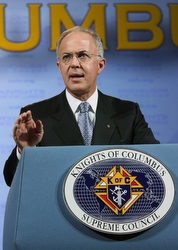
The Supreme Knight of the Knights of Columbus, Carl A. Anderson, said that the upcoming beatification of Pope John Paul II signaled the inspiring rise of a new generation of Catholics, formed by the beloved pontiff's example and teachings.

On Jan. 14, Pope Benedict XVI approved plans for the May 1, 2011 beatification of his predecessor, who died on April 2, 2005.

Throughout his 26-year reign, Pope John Paul II –who currently bears the title “Venerable”– was noted for his special appeal to young people, often providing a striking counterexample to the cynicism that came to characterize popular culture during the 1980s and 90s.

The Supreme Knight described the upcoming beatification ceremony, which will permanently place the late Pope's memorial on the Church's liturgical calendar, as “a validation of the 'John Paul II generation'.” Countless young people, he recalled, had their lives changed while attending the late Pope's celebrations of World Youth Day.

“Young adults especially look for authenticity,” the Anderson observed. “They can judge authenticity when they experience it.”

In their encounters with Pope John Paul II, young people could sense that “he loved them,” and loved God wholeheartedly. “The secret of so many World Youth Days,” he said, “was that relationship … They understood that it was authentic.”

Anderson reflected that the Pope upheld love, both human and divine, as the “underlying theme” of his pontificate – proclaiming to the world “the fundamental Gospel command, love of one's neighbor.” This emphasis on human participation in God's love made his message unusually accessible to young people, and to all the lay faithful.
“The more people get to know John Paul II, the more they will be uplifted,” he said, citing the Pope's personal witness to a vision of life “premised on the fundamental commandments of the Christian faith: love of God, and love of neighbor.”
“That's what he stood for throughout his life, and made so apparent for all to see,” Anderson noted, upholding the Pope as a man who strove to inspire others through his own example.

He spoke warmly of his own encounters with the Pope, recalling that he gave his full attention and care to anyone he met. “Every time you met John Paul II, you had his attention. He was interested in you.”

Supreme Knight Anderson pointed out that the beatification had a special relevance to Americans, a people who were close to the late Pope's heart. John Paul II recognized the nation's cultural and political ascendancy during his reign, and was “very concerned about what we did as a society, and our future.”

“I hope that Americans, and American Catholics especially, will look to his beatification – to take pause, and remember what he told us.”

“We should remember those words,” the Supreme Knight advised, recalling the Pope's exhortations for Catholics, and all people of good will, to “stand up when human rights are attacked, when the unborn are threatened, when marriage is undermined, and the poor and suffering are neglected.”

Friday, January 14, 2011

Pope John Paul to be beatified on Divine Mercy Sunday - May 1

from AP.org

Pope John Paul on the Fast Track to Sainthood


The pope on Friday signed off on the miracle needed for the beatification of Pope John Paul II, and set May 1 as the date to honor one of the most beloved popes of all times as a model of saintliness for the church.

Pope Benedict XVI said in a decree that a French nun's recovery from Parkinson's disease was miraculous, the last step needed for beatification. A second miracle is needed for the Polish-born John Paul to be made a saint.

The May 1 beatification, which Benedict himself will celebrate, is expected to draw hundreds of thousands of pilgrims to Rome — a major morale boost for a church reeling from a wave of violence against Christians and fallout from the clerical sex abuse scandal.

Once he is beatified, John Paul will be given the title "blessed" and can be publicly venerated. Many people, especially in Poland, already venerate him privately, but the ceremony will make it official.

"This is a huge and important cause of joy," Warsaw Archbishop Kazimierz Nycz told reporters at his residence in the Polish capital.

Cardinal Stanislaw Dziwisz, John Paul's longtime secretary and friend, expressed "huge thanks" to Benedict for the decree. "We are happy today," he said.

Benedict put John Paul on the fast track to possible sainthood just weeks after he died in 2005, responding to the chants of "Santo Subito!" or "Sainthood immediately!" that erupted during his funeral.

Benedict waived the typical five-year waiting period before the process could begin, but he insisted that the investigation into John Paul's life be thorough so as to not leave any doubts about his virtues.

The last remaining hurdle concerned the approval by Vatican-appointed panels of doctors and theologians, cardinals and bishops that the cure of French nun, Sister Marie Simon-Pierre, was a miracle due to the intercession of John Paul.

The nun has said she felt reborn when she woke up two months after John Paul died, cured of the disease that had made walking, writing and driving a car nearly impossible. She and her fellow sisters of the Congregation of Little Sisters of Catholic Maternity Wards had prayed to John Paul, who also suffered from Parkinson's.

Last year, there were some questions about whether the nun's original diagnosis was correct. But in a statement Friday, the Congregation for the Causes of Saints said Vatican-appointed doctors had "scrupulously" studied the case and determined that her cure had no scientific explanation.
Born in Wadowice, Poland, in 1920, Karol Wojtyla was the youngest pope in 125 years and the first non-Italian in 455 years when he was elected pope in 1978.

He brought a new vitality to the Vatican, and quickly became the most accessible modern pope, sitting down for meals with factory workers, skiing and wading into crowds to embrace the faithful.

He was the most traveled pope ever, visiting more than 120 nations during the third-longest papacy and covering distance equal to nearly 1 1/2 trips to the moon.

His Polish roots nourished a doctrinal conservatism — opposition to contraception, euthanasia, abortion and women priests — that rankled liberal Catholics in the United States and Western Europe.

But his common touch also made him a crowd-pleasing superstar whose 26-year papacy carried the Roman Catholic Church into Christianity's third millennium and emboldened eastern Europeans to bring down the communist system.

He survived an assassination attempt in St. Peter's Square in 1981 — and then forgave the Turk who had shot him.

He died in his Vatican apartment on April 2, 2005 after suffering for years from the effects of Parkinson's disease. He was 84.

While adored by Catholics, John Paul did not escape scrutiny about the clerical abuse scandal which came to light in the final years of his papacy. Many of the thousands of sexual abuse cases that emerged in Europe and beyond last year concerned crimes or cover-ups that occurred under his watch.

Vatican officials have said there was nothing in John Paul's record that called into question his path to beatification.

Carl Anderson, head of the Knights of Columbus, one of the world's largest Catholic fraternal service organizations, noted that John Paul's beatification process is not a "score card on his administration of the Holy See."

Rather, he said, it's a statement about his personal sanctity since beatification is way of holding up Catholics as models for the faithful.

"Pope John Paul's life is precisely such a model because it was lived beautifully and with love, respect and forgiveness for all," Anderson told the AP in an e-mail. "We saw this in the way he reached out to the poor, the neglected, those of other faiths, even the man who shot him. He did all of this despite being so personally affected by events of the bloodiest century in history."

Wednesday, January 12, 2011

John Paul II beatification in October?

from whispersintheloggia.blogspot.com

In a development that promises to spark intense reactions across the ecclesial spectrum, Italian reports this morning declare that, nearly six years since his last hospitalization began, Pope John Paul II's path to beatification has cleared its final hurdle.

Under the headline, "The cardinals OK the miracle, Wojtyla will be beatified," the most reliable of vaticanisti --Andrea Tornielli of Il Giornale -- revealed that the cardinal-members of the Congregation for the Causes of Saints voted yesterday to affirm the finding of the dicastery's medical board that no natural explanation could be found for the healing of a French nun from Parkinson's disease, the same condition which ravaged the Polish Pope in the final act of his monumental 27-year reign.

With the miracle approved, all that remains is for Pope Benedict to accept the conclusion -- something which would normally take place in a routine private audience with the prefect of the Congregation, Cardinal Angelo Amato, which could occur within days. Preparations would then begin in earnest for what will inevitably end up being the Vatican's biggest gathering since the late pontiff's 2005 funeral, which drew 5 million people to Rome; according to Tornielli, the formal beatification rites could take place in the fall, with 16 October -- the anniversary of John Paul's 1978 election (and, conveniently, a Sunday this year) -- cited as the most likely date.

Thanks in part to the waiving of the traditional "five-year rule" to open the cause on the part of the then newly-elected Benedict XVI, the process bringing the church's greatest saintmaker in history to the penultimate step to sainthood in his own right has reached the milestone with a speed matched by but one other figure: Mother Teresa of Calcutta -- of course, celebrated in life as a saint -- who was raised to the altars by John Paul six years after her 1997 death, but whose required miracle for canonization remains pending.


Read entire post here...