Showing posts with label John the Baptist. Show all posts

Friday, June 24, 2011

Feast day brings crowds to Roman church where John the Baptist's head is displayed


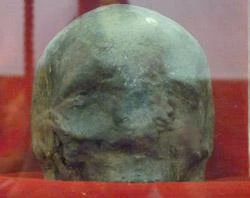
Head of John the Baptist at San Silvestro in Capite
 Catholic News Agency:

June 24 is the Feast Day of St. John the Baptist's birth and that means a very busy day for Father John Fitzpatrick, the rector of the Church of San Silvestro in Capite, where the decapitated head of St. John is kept on public display.

“It is very important to keep the head of St. John the Baptist from the point of view of telling his story, because he was the forerunner of Jesus Christ,” the Pallotine priest told CNA.

“People come here to lay flowers, light candles and pray. They come from everywhere, even from Russia or Romania, and in great numbers to visit the relic. In fact, it would be difficult to count the number of pilgrims who come to the Church,” he said.

St. John the Baptist was the last great prophet to herald the birth of Jesus Christ. In fact, he was related to Jesus as the son of Elizabeth who was a cousin of Mary, the mother of Christ.

The Gospel of Luke states that Jesus was conceived when Elizabeth was about six months pregnant. For that reason, the Church places today’s feast day six months before Christmas and the birth of Christ.

Fr. Fitzpatrick said that the head was brought to Rome by Greek monks in the year 1169. The monks then founded a church dedicated to the 4th-century Pope St. Sylvester and to the decapitated head of St. John—a dual tribute reflected in the church’s name.

In the Gospel accounts of John the Baptist’s death, King Herod had the prophet imprisoned for denouncing his marriage to his brother’s wife, Herodias. The King then had John beheaded following a request from Herodias’ daughter, Salome.

The head in St. Silvestro in Capite is kept on a red velvet cloth within a clear plastic box.

There are other religious sites around the world that also claim to house the remains of St. John the Baptist, including the Umayyad Mosque in the Syrian city of Damascus. 

Thursday, June 23, 2011

John the Baptist baptizes Jesus

Today's celebration • June 24 • The Birth of John the Baptist

Jesus called John the greatest of all those who had preceded him: “I tell you, among those born of women, no one is greater than John....” But John would have agreed completely with what Jesus added: “[Y]et the least in the kingdom of God is greater than he” (Luke 7:28).

John spent his time in the desert, an ascetic. He began to announce the coming of the Kingdom, and to call everyone to a fundamental reformation of life.

His purpose was to prepare the way for Jesus. His Baptism, he said, was for repentance. But One would come who would baptize with the Holy Spirit and fire. John is not worthy even to carry his sandals. His attitude toward Jesus was: “He must increase; I must decrease” (John 3:30).

John was humbled to find among the crowd of sinners who came to be baptized the one whom he already knew to be the Messiah. “I need to be baptized by you” (Matthew 3:14b). But Jesus insisted, “Allow it now, for thus it is fitting for us to fulfill all righteousness” (Matthew 3:15b). Jesus, true and humble human as well as eternal God, was eager to do what was required of any good Jew. John thus publicly entered the community of those awaiting the Messiah. But making himself part of that community, he made it truly messianic.

The greatness of John, his pivotal place in the history of salvation, is seen in the great emphasis Luke gives to the announcement of his birth and the event itself—both made prominently parallel to the same occurrences in the life of Jesus. John attracted countless people (“all Judea”) to the banks of the Jordan, and it occurred to some people that he might be the Messiah. But he constantly deferred to Jesus, even to sending away some of his followers to become the first disciples of Jesus.

Perhaps John’s idea of the coming of the Kingdom of God was not being perfectly fulfilled in the public ministry of Jesus. For whatever reason, he sent his disciples (when he was in prison) to ask Jesus if he was the Messiah. Jesus’ answer showed that the Messiah was to be a figure like that of the Suffering Servant in Isaiah (chapters 49 through 53). John himself would share in the pattern of messianic suffering, losing his life to the revenge of Herodias.

Comment:
John challenges us Christians to the fundamental attitude of Christianity—total dependence on the Father, in Christ. Except for the Mother of God, no one had a higher function in the unfolding of salvation. Yet the least in the kingdom, Jesus said, is greater than he, for the pure gift that the Father gives. The attractiveness as well as the austerity of John, his fierce courage in denouncing evil—all stem from his fundamental and total placing of his life within the will of God.

Quote:
"And this is not something which was only true once, long ago in the past. It is always true, because the repentance which he preached always remains the way into the kingdom which he announced. He is not a figure that we can forget now that Jesus, the true light, has appeared. John is always relevant because he calls for a preparation which all men need to make. Hence every year there are four weeks in the life of the Church in which it listens to the voice of the Baptist. These are the weeks of Advent" (A New Catechism).